Here is the part nobody softens for you: with private mortgage insurance, you pay every premium and the lender gets all the protection. If you stop paying and the foreclosure does not cover the balance, PMI reimburses the bank. It does nothing for you, your family, or your equity.
That sounds outrageous until you see what it buys: the ability to own a home years before you would otherwise have saved enough cash. PMI is the toll for entering with less than twenty percent down. It is also temporary, governed by federal law, and far more controllable than most buyers realize. Knowing exactly how it is priced and when it must legally come off is worth thousands of dollars.
What it is, and three things people confuse it with
Private mortgage insurance is a policy your lender requires when your down payment on a conventional loan is under 20%. Low-down-payment loans default more often, so the lender offloads that risk and bills you for the policy.
The word "insurance" causes three expensive mix-ups:
| Type | Protects | Roughly how long |
|---|---|---|
| PMI (conventional) | The lender | Until you reach ~20% equity |
| MIP (FHA) | The lender | Often the entire life of the loan |
| Homeowners insurance | You | Always, the whole loan |
This article is about conventional PMI. FHA's version, MIP, is a different animal with much less forgiving rules, and on many FHA loans it does not fall off no matter how much you pay down. If you have an FHA loan, the usual way out is refinancing into a conventional one once you have the equity.
What it actually costs
PMI is quoted as an annual percentage of the loan and collected monthly. The range is roughly 0.3% to 1.6% per year, and two things decide where you land: how small your down payment is, and how strong your credit is.
Run the simple version on a $300,000 loan at a 0.7% rate. Annual PMI is $300,000 × 0.007 = $2,100. Divide by twelve and you are paying about $175 a month for a policy that protects someone else. Four years of that is $8,400. The PMI Calculator will do this for your numbers and adjust for your loan-to-value and credit tier, which matters more than people expect:
| Credit band | Typical PMI rate | Monthly on a $300k loan |
|---|---|---|
| 760+ | ~0.30%–0.45% | ~$75–$115 |
| 700–759 | ~0.50%–0.75% | ~$125–$190 |
| 660–699 | ~0.85%–1.15% | ~$215–$290 |
| Below 660 | ~1.25%–1.60% | ~$315–$400 |
Look at the spread. The same house, the same loan, can cost one borrower $90 a month and another $360, purely on credit. Raising a score from the high 600s into the 760s before applying can cut the PMI bill by more than half, on top of improving the interest rate. The single most profitable thing many buyers can do is spend a few months on their credit before they ever talk to a lender.
Four flavors, and which one is usually cheapest
Lenders may offer PMI in more than one shape, and the default is not always the one they pitch first.
Borrower-paid monthly PMI is the standard: a monthly premium that you can cancel later. Because it ends, it is usually the best long-run value for someone who will stay and build equity. Single-premium PMI is one upfront lump sum, sometimes covered by a seller or lender credit; it kills the monthly line but is generally not refundable if you sell early. Lender-paid PMI hides the cost inside a permanently higher interest rate, which sounds clean until you notice a higher rate never cancels and can outlast the equity threshold by decades. Split-premium PMI is a smaller upfront amount plus a reduced monthly premium, a middle path.
For most people who plan to stay several years and will cross the 20% line, the boring monthly version wins specifically because it has an off switch. The trap is lender-paid PMI, which is marketed as "no PMI" because there is no separate line. There is no line because it was baked into a permanently higher rate, and a higher rate does not cancel at 80%, 78%, or ever. On a $300,000 loan a rate bumped a quarter point to bury the PMI can cost more over a long hold than the cancellable monthly premium it replaced, while feeling cheaper because the unpleasant line item is gone. "No PMI" almost always means "PMI you can no longer see and can no longer cancel." Make the lender show you the same loan with borrower-paid monthly PMI and compare the total, not the presence or absence of a line.
Three honest ways to avoid it
Put twenty percent down. The clean answer, and the Down Payment Calculator will turn that target into a monthly savings number you can actually act on. Be honest, though, about the cost of waiting years to get there while prices and rents move.
Use a piggyback structure. An 80% first mortgage, a 10% second loan, and 10% cash keeps the first loan at 80% LTV with no PMI. You have traded PMI for a second loan that often carries a higher rate, so run the all-in cost both ways rather than assuming "no PMI" automatically wins.
Use a program that does not require it. Some lender programs and, for eligible veterans, VA loans skip mortgage insurance entirely. These usually move the cost somewhere else, into the rate or a funding fee, so compare the total, not the absence of one line item.
Getting rid of PMI you already pay: the law is on your side
This is where borrowers leave the most money on the table, because they wait passively when they could act. For most conventional loans on a primary residence, the Homeowners Protection Act gives you three rights.
At 80% of the home's original value, you may request cancellation in writing. The servicer can require you to be current and may ask for an appraisal to confirm the value has not dropped. This is the lever you pull yourself, and you should pull it the moment you qualify rather than waiting for the automatic point.
At 78% of the original value, the servicer must terminate PMI automatically, as long as you are current. You do not have to ask, but you absolutely should verify it actually happened on the next statement, because errors occur.
If neither has triggered by the loan's amortization midpoint, PMI must end then anyway, assuming you are current.
There is a fourth lever the rules do not advertise. The thresholds above use the original value, but many servicers will also cancel based on the current value if your home has appreciated or you have improved it. In a rising market, paying for a fresh appraisal that proves you already have 20% equity can end PMI years early and pay for itself many times over. Confirm your servicer's specific policy before ordering anything.
The credit-score lever, with the dollars attached
The single most profitable PMI move happens before you apply, and it is almost never framed as a PMI move. Return to the credit table: a borrower in the 660–699 band on a $300,000 loan pays roughly $215–$290 a month, while the same borrower at 760+ pays roughly $75–$115. That is a swing of about $150 a month, $1,800 a year, for the years until cancellation, and it stacks on top of the better interest rate a higher score also earns. Put concretely, lifting a score from 690 to 760 before applying can be worth well over $10,000 across the life of a low-down loan from PMI alone. The work is unglamorous and slow: pay revolving balances down so utilization drops, never miss a payment in the months before applying, dispute genuine reporting errors, and do not open or finance anything new. Spending three to six months on this before talking to a lender is frequently the highest hourly-rate task in the entire purchase, and it is invisible precisely because it happens before anyone is looking at houses.
Waiting for 20% versus paying PMI, run honestly
The instinct to avoid PMI entirely by waiting for 20% deserves the same arithmetic as any other timing decision. Suppose you can buy now with 5% down and about $175 a month in PMI that cancels in roughly four years, total PMI cost on the order of $8,000. Against that, waiting the years it takes to save 20% means continued rent that usually rises, no appreciation on a home you do not yet own, and, in many markets, a purchase price that climbs while you save, moving the 20% target away from you. In a flat or falling market, waiting can genuinely win and the avoided PMI is real money kept. In a rising one, the rent paid and appreciation missed routinely exceed the $8,000 of PMI several times over. PMI is not automatically the enemy and 20% is not automatically the goal; both are inputs to a comparison you should actually run with the Down Payment Calculator using your local rent and price trend, not a rule to obey on reflex.
The appraisal tactic that ends PMI years early
Here is the lever buyers most consistently leave unused. The automatic 78% termination and the requestable 80% cancellation both key off the home's original value, but many servicers will also cancel based on current value if the home has appreciated or you have improved it. In a market that has risen since you bought, ordering a fresh appraisal that proves you already hold 20% equity can end PMI long before the original-value schedule would have. Walk the numbers: if you are paying $200 a month and an appraisal costs a few hundred dollars but ends PMI a full year early, you have spent a few hundred to save roughly $2,400, a return few investments match. The catch is that policies and seasoning requirements vary by servicer, so confirm exactly what yours will accept before paying for an appraisal. The point stands regardless: PMI removal is something you pursue, not something you wait to receive.
A realistic timeline
Picture a buyer who puts 5% down on a $300,000 home with mid-600s credit, paying around $230 a month in PMI. They spend the first year making every payment on time and nudging the credit score up. Prices in the area rise modestly. By year three, between principal paid and appreciation, an appraisal shows they are at 21% equity. They send a written cancellation request the week they cross 20% on the original-value math, rather than coasting to the 78% automatic point a year later. That single letter, sent on time instead of late, is worth roughly a year of premiums.
That is the whole game with PMI: it is not the cost that hurts people, it is treating it as permanent and not acting the day it becomes optional.
Questions readers actually ask
Does PMI ever protect me if I lose my job? No. It pays the lender after a default. Only your own emergency fund and standard homeowners insurance protect you. Build the reserve; do not confuse PMI for one.
Can I cancel FHA MIP the same way? Usually not. On many modern low-down FHA loans, MIP lasts the life of the loan, and the common exit is refinancing into a conventional loan once you have 20% equity. Check your specific note.
Is buying now with PMI smarter than waiting for 20%? Sometimes, clearly so. If local prices and rents are climbing faster than you can save, a few years of cancellable PMI can be cheaper than a few years of waiting. Model both timelines instead of treating "avoid PMI" as a commandment.
The one mistake to avoid is the quiet one: reaching 20% equity and not noticing, or noticing and not sending the letter. Mark the date you expect to hit it, watch your local prices in case you get there sooner, and act the day you qualify. PMI is unusual among housing costs in that it is the one large line specifically engineered to end, and it ends faster for the borrower who treats removal as an active project, raise the score before applying, choose the structure with an off switch, watch local values, and send the cancellation request the week you cross the threshold rather than coasting to the automatic one a year later. Every one of those moves is worth real money, and not one of them happens unless you do it. The cost of PMI rarely hurts people. Treating it as permanent and waiting passively is what does.
Run the numbers
Everything below came out of this site's own Down Payment Calculator. The figures are not quoted from anywhere else: each row is one run of the same calculation the tool page performs, using August 2026 rules. Put the same inputs in and you will get the same output.
How the result moves with price
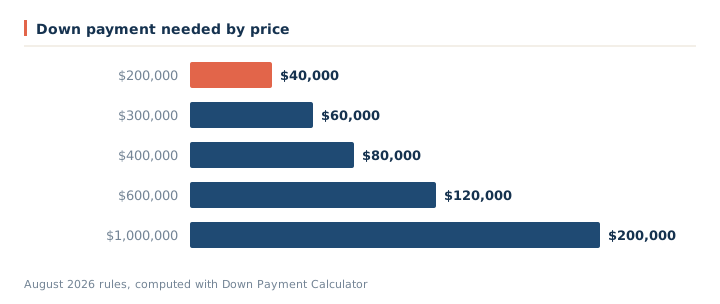
We ran 5 values of price through the calculator and left every other input at its default. As of August 2026, the output was:
| Price ($) | Down payment needed ($) | Still to save ($) | Months to goal (months) |
|---|---|---|---|
| 200,000 | 40,000 | 10,000 | 7 months |
| 300,000 | 60,000 | 30,000 | 20 months |
| 400,000 | 80,000 | 50,000 | 34 months |
| 600,000 | 120,000 | 90,000 | 60 months |
| 1,000,000 | 200,000 | 170,000 | 114 months |
Running price from $200,000 up to $1,000,000 moves down payment needed from $40,000 to $200,000 — a spread of $160,000. That gap is the part a single headline rate never shows.
The same runs seen through still to save
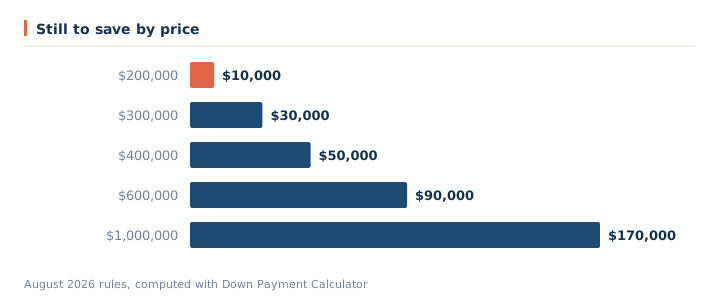
At $200,000, still to save works out to $10,000; at $1,000,000 it is $170,000. Looking only at down payment needed tends to understate how much the outcome shifts across that range.
Assumptions behind these figures
| Input | Value |
|---|---|
| Price | $400,000 |
| Target percent | 20% |
| Saved | $30,000 |
| Monthly savings | $1,500 |
| As of | August 2026 |
| Method | identical to /tools/down-payment-calculator |
Brackets, thresholds and rates change from year to year, so treat these as August 2026 figures for the 2026 tax year. For your own situation, open the Down Payment Calculator and enter your real numbers — the calculator runs the same code that produced every figure on this page.