Most buyers negotiate the interest rate to the last eighth of a percent and barely glance at the cost that will still be there long after the mortgage is gone. Property tax can add hundreds of dollars to a monthly payment, varies more dramatically across the country than almost any other housing expense, and unlike the loan, it never gets paid off.
How it actually works
Local governments, counties, cities, school districts, levy property tax to fund schools, roads, and services. The mechanism is roughly assessed value times a tax rate. Assessed value is the taxable value the local assessor assigns, which may differ from market value depending on local rules. The rate is the combined figure of every overlapping authority, often quoted in mills, dollars per thousand of value. Because several authorities stack their rates, two homes a few miles apart in different school districts can carry noticeably different bills.
The number that lets you compare anything
Comparing millage rules across states is hopeless, so use the effective rate: annual tax paid divided by market value, which folds everything into one comparable percentage. A 1.0% effective rate on a $400,000 home is $4,000 a year, about $333 a month added to your payment, forever. The Property Tax Calculator applies a state effective rate to your price so you see that number before you make an offer rather than after.
Two houses, same price, different states
The effective rate stops being abstract when you put two purchases side by side. Same $400,000 home, two states:
| Low-tax state (~0.5%) | High-tax state (~2.1%) | |
|---|---|---|
| Annual property tax | ~$2,000 | ~$8,400 |
| Added to monthly payment | ~$167 | ~$700 |
| Over 10 years | ~$20,000 | ~$84,000+ |
The price is identical. The cost of owning is not even close. That $533 monthly gap is larger than many buyers' entire car payment, it never ends, and it tends to rise with assessments over time. A buyer who shopped purely on sticker price and mortgage rate, and there are many, could pay tens of thousands more over a decade than a neighbor who bought a pricier home in a lower-tax state. This is also why property tax frequently dwarfs the mortgage-insurance line everyone frets about: in the high-tax column it exceeds typical PMI several times over and, unlike PMI, it has no cancellation point. The lesson writes itself, and the next sections are about not learning it the expensive way.
Why states differ so wildly
| Profile | Pattern | Buyer implication |
|---|---|---|
| No income tax, high property tax | Higher monthly escrow | A lower price may not mean lower total cost |
| High income tax, low property tax | Lower monthly escrow | Tax is a smaller payment factor |
| Strong assessment caps | Low effective rate for long holders | New buyers may be reassessed higher |
Effective rates range from well under 0.5% to over 2%. The spread comes from tax-mix tradeoffs (states with no income tax often lean hard on property tax), school-funding models, assessment caps that limit how fast taxable value rises, and the simple fact that rates are set locally so intra-state variation can rival the variation between states. The practical lesson: a cheaper sticker price in a high-tax state can carry a higher monthly cost than a pricier home in a low-tax one. Compare the all-in payment, never the price alone.
Estimate it before you write the offer, not after
The entire problem is timing: most buyers learn their real tax bill after they are emotionally and contractually committed, when it is a constraint instead of a choice. Reverse that. Before you make an offer, take the purchase price you are considering, multiply by the local effective rate, divide by twelve, and add that figure to the principal, interest, and insurance you already planned for. That four-step estimate, done in the Property Tax Calculator in under a minute, tells you the true monthly cost of this specific house in this specific jurisdiction while you can still change your mind, negotiate, or look one town over where the rate is half as much. A buyer who runs this number on three candidate homes often finds the cheapest sticker price is the most expensive house to own, and learns it during shopping rather than at the first escrow analysis. The tax is not the surprise; not estimating it is.
The improvement and new-construction gotcha
Two situations reliably blindside owners. The first is new construction: the tax quoted or escrowed at closing is sometimes based on the land or a partial assessment, then jumps once the finished home is fully assessed, occasionally a large, delayed increase a year or two in. The second is your own improvements. A significant addition or major renovation can trigger a reassessment that raises the bill, so the project that improved the home also quietly raised its annual cost for as long as you own it. Neither is a reason to avoid building or improving; both are reasons to model the post-assessment tax, not the pre-assessment one, before committing. The pattern across this entire topic repeats here: the dangerous number is always the future assessed value, and the safe habit is always to estimate from it rather than from whatever figure is conveniently in front of you today.
How you actually pay it, and why a "fixed" payment moves
Most owners with a mortgage do not pay tax in a lump sum. The lender collects about a twelfth of the estimated annual tax with each payment, holds it in escrow, and pays the bill for you. This is why a fixed-rate payment can still rise: the escrow portion grew, not the interest. Lenders periodically run an escrow analysis and adjust the payment up or down, sometimes with a shortage to make up. It is the single most common reason borrowers are confused when a "fixed" payment changes.
An escrow analysis, walked through
Because the "fixed payment that moved" confuses more borrowers than almost anything else, follow one. You buy and the lender estimates $4,000 in annual tax, so it collects about $333 a month into escrow. A year later the county reassesses your home upward and the bill becomes $4,800. Two things now happen at the annual escrow analysis. First, the monthly collection rises to about $400 to cover the new bill going forward. Second, the account ran short for the months it was under-collecting, often several hundred dollars, and the lender either spreads that shortage over the next twelve months or asks for it in a lump sum. So a borrower with a genuinely fixed interest rate can open a statement and find the payment jumped by $90 or more, with nothing about the loan having changed. The interest is fixed; the escrow is not, and the escrow is part of the payment. Knowing this in advance turns a panic phone call into an expected, explainable adjustment.
The reassessment trap, with numbers
Here is how buyers get genuinely blindsided. A seller bought their home twenty years ago, and under a local assessment cap their taxable value rose slowly while the market did not. They are paying tax as if the home were worth $180,000 even though it is selling to you for $420,000. You tour the house, you ask the agent about taxes, you are quoted the seller's roughly $2,300 annual bill, and you budget around it. Then the sale triggers a reassessment to current market value, and your bill resets toward what a $420,000 home actually owes, perhaps $5,000 or more. Nothing was hidden; you simply budgeted off a number that was about to expire. The rule that prevents this is unbendable: never trust the seller's tax figure. Estimate from your purchase price and the local effective rate with the Property Tax Calculator, and treat any lower number on the listing as the previous owner's history, not your future.
The surprise after you buy, and the relief you must ask for
In many places a sale triggers a reassessment to current market value. If the prior owner held the home for years under an assessment cap, the bill you inherit can be far higher than what they paid, so never budget off the seller's old tax figure; estimate from your purchase price and the local effective rate. On the other side, many jurisdictions offer relief you must apply for rather than receive automatically: a homestead exemption for a primary residence, senior, veteran, or disability reductions, assessment caps, and a formal appeal if you believe the assessed value is too high and have comparable evidence. These vary widely and change, so confirm what applies with your local assessor after closing. ## The exemptions you have to claim, because no one applies them for you
Relief exists almost everywhere and is routinely left on the table because it is opt-in, not automatic. The homestead exemption reduces the taxable value of a primary residence and, in many places, also caps how fast that value can rise each year, which over a long hold is worth far more than the first-year reduction alone. Layered on top are common targeted reductions for seniors, veterans, people with disabilities, and sometimes surviving spouses, each with its own eligibility and its own form. The amounts and rules vary widely by jurisdiction and change over time, so the only reliable move is to contact your local assessor in the weeks after closing and ask, plainly, which exemptions you qualify for and what the filing deadlines are. None of these find you. A buyer who never asks can pay years of fully unreduced tax on a home that qualified for relief the entire time, and there is rarely a refund for the years you simply did not file.
Appealing an assessment is a real lever, not a long shot
Homeowners treat the assessed value as a verdict; it is closer to an opening offer. Jurisdictions have a formal appeal process, usually with a tight annual window, and a meaningful share of appeals succeed because mass assessment is imprecise by nature. The work is unglamorous and effective: pull recent sale prices of genuinely comparable homes near you, check the assessor's record of your property for plain errors, wrong square footage, a bathroom that does not exist, a finished basement that is not, and present the comparables and corrections within the deadline. A successful appeal does not shave a few dollars; lowering the assessed value lowers the bill every year until the next reassessment, so the payoff compounds. The catch is the window. Miss it and you wait a full cycle, which is why this belongs on the post-closing task list, not the someday list.
The cost that is still there when the mortgage is gone
Every other line in this article eventually ends. The loan amortizes to zero. PMI cancels. Even the escrow shortage gets caught up. Property tax does none of that. Thirty years in, with the mortgage fully paid, the tax bill is not only still arriving, it is almost certainly larger than the day you bought, because assessed values trend upward over decades. This reframes a decision most people make only about the loan: when you evaluate affordability, and especially when you think about owning the home into retirement on a fixed income, the permanent, inflation-tracking tax line matters more than the temporary, fixed mortgage payment. A house can be "paid off" and still carry a four- or five-figure annual obligation that never stops. Budgeting that reality with the Mortgage Affordability Calculator up front is the difference between a home that becomes cheaper to own over time and one that quietly becomes a liability exactly when income falls.
The honest summary is that property tax is a permanent, location-driven cost that can rival many other ownership expenses, behaves differently in every state, and rewards exactly one habit: estimate it from your purchase price up front with the Property Tax Calculator, fold it into your real budget with the Mortgage Affordability Calculator, and claim every exemption you qualify for the moment you can. Treat it with the same seriousness you give the interest rate you negotiated so hard, because over the decades you own the home it can quietly cost you more than the rate ever did, and unlike the loan, it sends a bill long after the mortgage is a memory.
Run the numbers
Everything below came out of this site's own Mortgage Affordability Calculator. The figures are not quoted from anywhere else: each row is one run of the same calculation the tool page performs, using August 2026 rules. Put the same inputs in and you will get the same output.
How the result moves with income
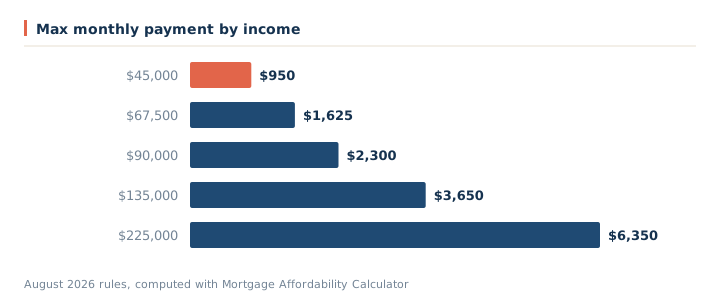
We ran 5 values of income through the calculator and left every other input at its default. As of August 2026, the output was:
| Income ($) | Max monthly payment ($) | Loan amount ($) | Home price affordable ($) |
|---|---|---|---|
| 45,000 | 950 | 150,300.28 | 210,300.28 |
| 67,500 | 1,625 | 257,092.58 | 317,092.58 |
| 90,000 | 2,300 | 363,884.88 | 423,884.88 |
| 135,000 | 3,650 | 577,469.49 | 637,469.49 |
| 225,000 | 6,350 | 1,004,638.7 | 1,064,638.7 |
Running income from $45,000 up to $225,000 moves max monthly payment from $950 to $6,350 — a spread of $5,400. That gap is the part a single headline rate never shows.
The same runs seen through loan amount
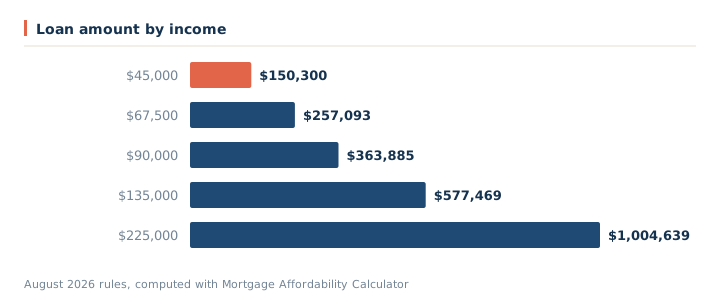
At $45,000, loan amount works out to $150,300; at $225,000 it is $1,004,639. Looking only at max monthly payment tends to understate how much the outcome shifts across that range.
Assumptions behind these figures
| Input | Value |
|---|---|
| Income | $90,000 |
| Monthly debts | $400 |
| Down payment | $60,000 |
| Rate | 6.5% |
| Term | 30 years |
| As of | August 2026 |
| Method | identical to /tools/mortgage-affordability-calculator |
Brackets, thresholds and rates change from year to year, so treat these as August 2026 figures for the 2026 tax year. For your own situation, open the Mortgage Affordability Calculator and enter your real numbers — the calculator runs the same code that produced every figure on this page.