If you are eligible for it, the VA loan is arguably the most powerful home-financing benefit in the country, and a surprising number of people who earned it never fully use what it offers. Backed by the Department of Veterans Affairs, it removes the two largest barriers to ownership in a single move.
What makes it so strong
Three advantages stack. There is no required down payment, so eligible borrowers can finance the full value of the home and the single biggest obstacle for most buyers simply disappears. There is no monthly mortgage insurance, not PMI, not MIP, which is a permanent monthly saving that compounds for decades. And because the VA partially guarantees the loan, lenders take on less risk and frequently offer competitive rates with more forgiving qualification. To feel what eliminating both the down payment and the monthly insurance does to a payment, put it side by side with a low-down conventional or FHA loan in the Mortgage Payment Calculator. The difference is not small.
Put the three loans on one payment line
The advantage stops being abstract the moment you see it in a payment. Take a $320,000 home for an eligible borrower with good credit:
| Loan | Down payment | Monthly insurance | Roughly what hits the account |
|---|---|---|---|
| VA, 0% down | $0 | None | P&I only on the full amount |
| FHA, 3.5% down | ~$11,200 | ~$175 (often for life) | P&I + ~$175 every month |
| Conventional, 5% down | $16,000 | ~$150 (until ~20% equity) | P&I + ~$150 for several years |
The VA borrower brings no down payment and pays no monthly insurance at all. Over the first ten years the FHA borrower in this picture pays on the order of $20,000 in mortgage insurance and the conventional borrower several thousand before cancellation; the VA borrower pays none of it. That recurring zero, repeated for the life of the loan, is the benefit, and it dwarfs almost every other variable in the comparison. See it in your own figures with the Mortgage Payment Calculator before you let anyone talk you into a different product.
The one real cost, kept in perspective
The VA loan is not literally free. In place of monthly insurance, most borrowers pay a one-time funding fee. It is a percentage of the loan rather than a recurring charge, it varies with your down payment and whether this is your first VA loan, and it can be financed into the loan instead of paid in cash. Many veterans with a service-connected disability rating are exempt from it entirely, which is one of the most frequently missed details in the whole process. Compared with paying PMI or life-of-loan MIP for years, a single financeable funding fee is usually dramatically cheaper, though if you have substantial cash a voluntary down payment lowers the fee further.
How the fee actually scales
The fee is not one number; it moves with two things, whether this is your first VA loan and how much you put down, and understanding the direction of those moves can save real money. A first-time use with zero down carries the highest percentage. A subsequent use with zero down is higher still. But putting even a modest voluntary amount down, often at the 5% and 10% thresholds, steps the fee percentage down meaningfully. So a borrower with some cash faces a genuine optimization: zero down preserves liquidity but pays the top fee, while a 5% or 10% voluntary down payment both lowers the fee and lowers the payment. There is no universally right answer; it depends on how much that cash is worth to you elsewhere. The mistake is not knowing the lever exists and defaulting to zero down out of habit when a small down payment would have paid for itself. And if a service-connected disability rating exempts you, the entire calculation disappears, which is exactly why confirming exemption status is not a footnote, it is one of the highest-value questions in the process.
Eligibility and entitlement, briefly
Eligibility is based on service history, not income and not whether you are a first-time buyer. You prove it with a Certificate of Eligibility, which many lenders can pull electronically during pre-approval. "Entitlement" is the amount the VA guarantees on your behalf, and for borrowers with full entitlement there is generally no VA loan limit; you can borrow what a lender approves on income and credit with no down payment. The benefit is also reusable. It is not a one-time card. Once a prior VA loan is paid off, or through a one-time restoration in certain cases, the entitlement can be used again on a future home, which matters when you plan moves across a career and a life.
Reusing it across a career, with a number
"Reusable" is easy to say and easy to underuse, so make it concrete. Suppose you buy with a VA loan, live there several years, then sell and pay off that loan. The entitlement that was tied up is restored, and you can use the benefit again, zero down, no monthly insurance, on the next home. Even keeping the first home is sometimes possible: a borrower with sufficient remaining entitlement can, in some cases, retain one VA-financed property and use bonus entitlement toward another, turning the benefit into a tool that follows an entire moving military or civilian career rather than a single-use coupon. The people who leave the most value on the table are not the ones who never qualified; they are the ones who used it once, assumed it was spent, and financed every subsequent home the expensive way.
Three advantages almost no one mentions
The headline trio, no down payment, no monthly insurance, competitive rates, gets all the attention, but three quieter features matter over a long hold. VA loans carry no prepayment penalty, so aggressively paying down principal is always free, which compounds the benefit for disciplined borrowers. VA loans are assumable: a qualified buyer can, with lender and VA approval, take over your existing loan and its rate, which becomes a real selling advantage if you locked a low rate and later sell into a high-rate market, something no conventional loan offers. And the program limits certain fees the lender can charge and restricts what the borrower can be made to pay, a built-in cost guardrail that does not exist on conventional financing. None of these is the reason to choose VA, but together they widen an already wide gap.
The appraisal protects you, with a tradeoff
A VA appraisal does two jobs: it sets value and it checks the home against Minimum Property Requirements for safety and livability. That protects you from buying into a hazardous house, but it also means a property in poor condition can be harder to finance with a VA loan than with some alternatives. It is a feature, with a known edge case.
What the benefit is worth in lifetime dollars
Naming the advantages undersells them; the total is what lands. Stay with the $320,000 home. An FHA borrower paying roughly $175 a month in mortgage insurance that never cancels pays on the order of $63,000 over a thirty-year life. A conventional borrower paying about $150 a month until cancellation around year eight pays in the neighborhood of $13,000–$14,000. The VA borrower pays neither, substituting a single funding fee, often a few thousand dollars, financed and frequently waived entirely for those with a qualifying disability rating. Net the funding fee against the insurance the other loans pay and the VA borrower is commonly tens of thousands of dollars ahead over the life of the loan on the insurance line alone, before counting the zero-down advantage of not having tied up a down payment, the absence of a prepayment penalty, and the assumability that can make the home easier to sell in a high-rate market. This is why "competitive" undersells the VA loan. For an eligible borrower it is not one option among several of roughly equal cost; it is usually the cheapest mortgage in the country, by a margin large enough that the burden of proof falls on any loan officer steering you elsewhere to explain why.
A short word on the funding fee math
Because the fee is the program's one real cost, it is worth seeing the lever move. On a $320,000 loan a top-tier first-use, zero-down fee versus the reduced fee that a 5% or 10% voluntary down payment unlocks can differ by thousands of dollars, and that is before the payment reduction the down payment itself produces. A borrower with no spare cash should not feel they are making a mistake by taking zero down; that is exactly the obstacle the program exists to remove. A borrower who does have cash, though, faces a genuine optimization between preserving liquidity and lowering both the fee and the payment, and the only wrong move is not realizing the choice exists. And the borrower with a service-connected disability rating should treat confirming their exemption as one of the highest-dollar five-minute tasks in the entire mortgage process, because financing a fee you never owed is the most quietly expensive mistake on this list.
How VA stacks up, and how to not waste it
| Factor | VA | FHA | Conventional 3–5% |
|---|---|---|---|
| Minimum down | 0% | 3.5% | 3%–5% |
| Monthly insurance | None | Often life-of-loan | Removable PMI |
| One-time fee | Funding fee (exemptions) | Upfront MIP | None |
For an eligible borrower the VA loan usually wins outright on total cost because it deletes monthly insurance. The ways people leave money on the table are avoidable. Make sure a lender is structuring a true VA loan rather than steering you into an FHA or conventional product. Decide deliberately whether a voluntary down payment makes sense, comparing both with the Mortgage Affordability Calculator, since it lowers the fee and the payment. Confirm whether a disability rating exempts you from the funding fee. Remember the benefit is reusable and plan future moves accordingly. And shop lenders anyway, because VA backing does not force every lender to offer the same rate or fees.
Where eligible buyers actually lose the benefit
The losses are rarely dramatic; they are quiet and avoidable. Some buyers are steered into an FHA or conventional loan because that is what a particular loan officer processes most or earns most on, and the borrower never knew to ask for a true VA loan, so insist on it by name. Some default to zero down without checking whether a small voluntary down payment would have lowered the funding fee enough to pay for itself. Some with a service-connected disability never confirm their funding-fee exemption and finance a fee they did not owe. Some assume a property in poor condition simply cannot be VA-financed and walk away when a different property, or a repair negotiation, would have worked. And some treat the benefit as spent after one use and pay full freight on every subsequent home for the rest of their lives. Every one of these is a knowledge gap, not a rule, which is the whole reason to learn the program before you shop it; weigh a voluntary down payment against keeping the cash with the Mortgage Affordability Calculator so the decision is yours and not a default.
It is also worth saying plainly that the VA loan is not automatically the right loan in every single case. A borrower with substantial cash who wants to put 20% down and never carry insurance anyway might find a conventional loan competitive, and an eligible buyer purchasing a property in poor condition may hit the appraisal's condition standards and need a different path for that specific house. These are edges, not the rule. For the large majority of eligible borrowers, particularly those who would otherwise face years of PMI or life-of-loan MIP, the VA loan wins on total cost and wins clearly. The point of the edges is only that you should choose it because the numbers confirm it for your situation, not as a reflex, which is the same standard every other decision in home financing deserves.
The honest summary is short. If you earned this benefit, it is usually the lowest-cost route to a home that exists, it follows you across a lifetime rather than expiring after one use, and the most common mistake is not understanding it well enough to insist on using all of it.
Run the numbers
Everything below came out of this site's own Mortgage Payment Calculator. The figures are not quoted from anywhere else: each row is one run of the same calculation the tool page performs, using August 2026 rules. Put the same inputs in and you will get the same output.
How the result moves with price
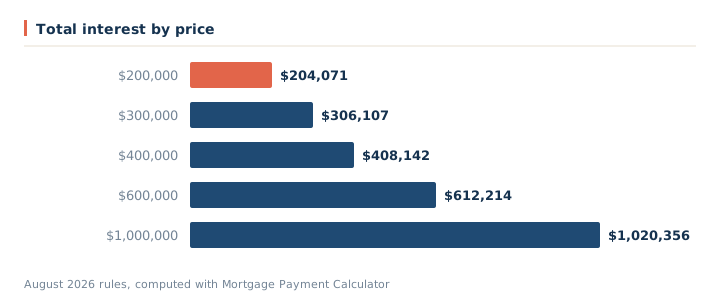
We ran 5 values of price through the calculator and left every other input at its default. As of August 2026, the output was:
| Price ($) | Total interest ($) | Total monthly payment ($) | Principal and interest ($) |
|---|---|---|---|
| 200,000 | 204,071.18 | 1,561.31 | 1,011.31 |
| 300,000 | 306,106.77 | 2,066.96 | 1,516.96 |
| 400,000 | 408,142.36 | 2,572.62 | 2,022.62 |
| 600,000 | 612,213.54 | 3,583.93 | 3,033.93 |
| 1,000,000 | 1,020,355.91 | 5,606.54 | 5,056.54 |
Running price from $200,000 up to $1,000,000 moves total interest from $204,071 to $1,020,356 — a spread of $816,285. That gap is the part a single headline rate never shows.
The same runs seen through total monthly payment
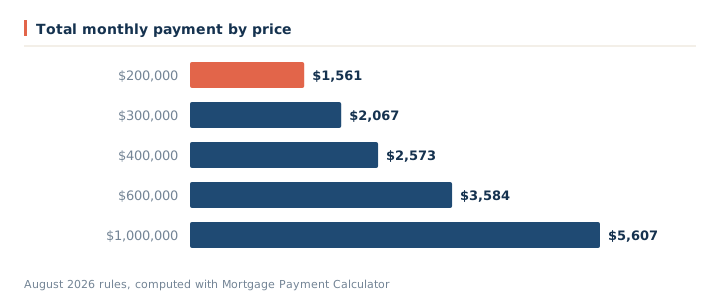
At $200,000, total monthly payment works out to $1,561; at $1,000,000 it is $5,607. Looking only at total interest tends to understate how much the outcome shifts across that range.
Assumptions behind these figures
| Input | Value |
|---|---|
| Price | $400,000 |
| Down payment percent | 20% |
| Rate | 6.5% |
| Term | 30 years |
| Property tax annual | $4,800 |
| Insurance annual | $1,800 |
| As of | August 2026 |
| Method | identical to /tools/mortgage-payment-calculator |
Brackets, thresholds and rates change from year to year, so treat these as August 2026 figures for the 2026 tax year. For your own situation, open the Mortgage Payment Calculator and enter your real numbers — the calculator runs the same code that produced every figure on this page.