Refinancing swaps your current mortgage for a new one, ideally cheaper. Done at the right time for the right reason it can save tens of thousands. Done at the wrong time it can lose you money even when the new rate looks lower on paper. The difference comes down to one calculation and a few honest questions.
Refinancing is not free, and that is the whole point
A refinance carries closing costs much like the original loan, often 2% to 5% of the balance. That cost is the entire reason timing matters. You only come out ahead if the savings eventually outrun what you paid to capture them. So the first and only number that decides it is the break-even point:
Break-even months = total refinance cost ÷ monthly saving
Concretely: $6,000 in costs, old payment $2,200, new payment $1,950, so $250 saved a month, and $6,000 ÷ $250 is 24 months. Keep the loan well past month 24 and refinancing wins. Sell or refinance again before it and you paid $6,000 to capture less than $6,000. Model your own numbers in the Mortgage Refinance Calculator before assuming a lower rate is automatically a win.
The same loan, four holding periods
The break-even is not advice; it is arithmetic that changes its answer with one variable, how long you stay. Hold the $6,000-cost, $250-saving refinance fixed and vary only the time you keep the loan:
| You keep the loan | Total saved | Net of $6,000 cost | Verdict |
|---|---|---|---|
| 18 months | $4,500 | −$1,500 | You lost money |
| 24 months | $6,000 | $0 | Exactly even |
| 5 years | $15,000 | +$9,000 | Clearly worth it |
| 10 years | $30,000 | +$24,000 | Strongly worth it |
Nothing in this table changed except time. The identical refinance is a $1,500 mistake and a $24,000 win depending only on a date you control. This is why "rates dropped, should I refinance" is an unanswerable question on its own. The rate sets the monthly saving; your holding period decides whether that saving ever outruns the cost. Anyone who quotes you a break-even without asking how long you will stay is doing half the calculation.
Rate-and-term versus cash-out are two different decisions
People say "refinance" as if it is one thing. It is two. A rate-and-term refinance replaces your loan with a cheaper or better-structured one and changes nothing about how much you owe; its entire justification is the break-even above. A cash-out refinance replaces your loan with a larger one and hands you the difference in cash, which means you are now paying mortgage interest, for up to thirty years, on whatever you took out. Those are not variations of the same move; they are a cost-reduction decision and a borrowing decision wearing the same name. A rate-and-term that clears break-even is straightforward. A cash-out only makes sense when the money is going toward something that outlasts or outperforms the decades of interest it now carries, retiring much higher-rate debt, or an investment in the home or yourself with a real return, never routine spending. Keep the two questions separate, because blending them is how a sensible refinance turns into expensive long-term debt that felt free on the day the cash arrived.
Reasons that genuinely justify it
A meaningfully lower rate is the classic case, and there is no magic "1% rule"; what matters is whether the break-even fits comfortably inside how long you will hold the loan. Shortening the term, refinancing a 30-year into a 15 or 20, can slash total interest dramatically for someone whose income has grown. Eliminating mortgage insurance, refinancing an FHA loan with life-of-loan MIP into a conventional loan once you have 20% equity, sometimes saves more than the rate change itself. Escaping a risky structure, moving off an adjustable or interest-only loan before a payment shock, can be worth it for the certainty even at a similar rate. And a disciplined cash-out to retire much higher-interest debt can make sense, with heavy emphasis on disciplined.
Shortening the term: the refinance that costs more monthly and saves the most
The most powerful refinance is often the one that raises your payment. Take that $270,000 balance with 22 years left at 7%. Refinancing into a 15-year loan at, say, 5.5% will lift the monthly payment, sometimes substantially, which makes most borrowers flinch and stop reading. But the lifetime interest on a 15-year loan at the lower rate is dramatically smaller than continuing 22 years at the higher one, frequently a six-figure difference on a loan this size. This is the refinance for a borrower whose income has grown since the original purchase: you are not chasing a smaller payment, you are buying a much earlier payoff and slashing total interest. It only works if the higher payment is genuinely comfortable, never at the expense of an emergency fund or retirement, but when it fits it is usually the highest-value version of refinancing, and it is the one billboards never advertise because "your payment goes up" does not sell.
Remember it is a brand-new approval
People treat a refinance as an adjustment to an existing loan; the lender treats it as an entirely new mortgage application. Your credit is pulled again, your income is documented again, and the home is appraised again. Each of those can move against you since the original purchase. A softer appraisal can push your loan-to-value high enough to trigger mortgage insurance or kill the deal; a credit score that dropped can mean the rate you are offered is nothing like the one advertised; a change in income or employment can complicate qualification. None of this means do not refinance; it means do not assume the advertised rate is your rate until you have a real quote on your real file, and build the appraisal and qualification risk into the timing rather than discovering it after you have paid for an application.
The trap that hides in plain sight
The most common hidden mistake is the term reset. If you are eight years into a 30-year loan and refinance into a fresh 30-year loan, you have just signed up to pay on this house for thirty-eight years total. Even at a lower rate, total interest can rise because you are paying interest for far longer.
Put numbers on it. You took $300,000 at 7% and you are eight years in; the balance is around $270,000 and you have 22 years left. A new 30-year loan at 5.5% drops the payment noticeably, and the billboard says you "saved" 1.5 points. But you just reset the clock from 22 years remaining to 30. You will now pay interest for eight extra years on this house. Run the totals and the lower-rate, longer-term loan can cost more in lifetime interest than the higher-rate loan you left, because more years of interest can outweigh a lower rate. The monthly payment fell and the total cost rose, and the monthly payment is the number the lender advertises.
The fix is simple and almost nobody does it: refinance into a term that ends around when the original would have, or shorter, and always compare total interest, not just the monthly payment. In the example, refinancing the $270,000 into a 20- or 22-year term at 5.5% captures the rate improvement without restarting the clock, and the total interest unambiguously falls. The lower rate was real; the longer term quietly took it back, and only looking at lifetime interest exposes the swap. A "no-cost" refinance is its own quiet trap; the costs are not gone, they are folded into a higher rate or balance. It can still be sensible, but understand you are paying, just differently. And cash-out to fund consumption converts equity into decades of new interest for something that will not last decades; reserve it for high-value, high-discipline uses, not as a spending account.
The "no-cost" refinance, decoded
A no-cost refinance is one of the more effective pieces of marketing in lending because the name is almost the opposite of the truth. The closing costs did not vanish; they were moved. Either they were added to your loan balance, so you now pay interest on them for the life of the loan, or you accepted a higher rate so the lender's rebate covers them, which means you pay them slowly forever through every monthly payment. Neither is dishonest and neither is automatically wrong. A no-cost structure can be the right call when you genuinely lack cash, or when you expect to move or refinance again soon enough that paying costs up front would never break even anyway. The error is believing the word "no-cost." Ask the lender for the same loan two ways, costs paid up front versus rolled in or rate-bought, compare the lifetime totals in the Mortgage Payment Calculator, and choose with the real number in front of you. The structure is a tool; the name is the trap.
When a lower rate still is not a reason to refinance
Sometimes the rate genuinely dropped and refinancing is still the wrong move, which surprises people who treat rate as the whole story. If you will sell before the break-even month, the lower rate cannot save you enough in time, no matter how good it looks. If you are far into a loan, refinancing into any longer term can raise lifetime interest even at a lower rate, as shown above. If your credit has slipped since the original loan, the rate you actually qualify for now may be worse than the advertised one that drew you in, so the comparison must use your real quote, not the headline. If a prepayment penalty still applies to your current loan, that penalty belongs in the cost side of the break-even and can erase the case entirely. And if the only motivation is a lower monthly payment achieved purely by stretching the term, that is not saving money, it is rescheduling it and usually paying more. A lower rate is necessary for most refinances to make sense; it is almost never sufficient on its own.
The streamlined path, if you already have a government loan
One detail saves eligible borrowers real money and is widely unknown: if you already hold an FHA or VA loan, there is often a streamlined refinance designed for exactly this situation, the FHA Streamline and the VA Interest Rate Reduction Refinance Loan. They typically require less documentation and sometimes skip a new appraisal, which lowers both the cost and the friction of the refinance and therefore shortens the break-even. This does not repeal the break-even rule, the costs are lower, not zero, so the same arithmetic still decides it, but a lower cost number moves the break-even closer and can turn a marginal refinance into a clearly worthwhile one. The takeaway is narrow and valuable: before you assume a conventional refinance and its full closing costs, find out whether the loan you already have qualifies for a streamlined version, because the program you ignored can change the answer the math gives.
Bad reasons that feel like good ones
Some refinance motivations are persuasive precisely because they are emotionally satisfying and financially backward. "I want to feel like I'm making progress" by lowering the payment, achieved purely by stretching the term, feels like relief and usually costs more over the life of the loan. "Rates dropped, I'd be foolish not to" ignores that a drop you cannot hold past break-even saves nothing. "I'll consolidate everything into the mortgage and finally be organized" converts short debt you would have cleared in a few years into thirty years of secured interest for the comfort of one statement. "My neighbor refinanced" is not a holding period, a balance, or a cost. Each of these can be turned from a feeling into a test by running the same six-question checklist below; the discipline is not resisting the feeling, it is refusing to act on it before the arithmetic agrees.
A checklist you can run in five minutes
Work through six questions in order. What is the all-in cost of the new loan, every fee, not just the rate? What is the monthly saving on a like-for-like comparison? What is the break-even month, cost divided by saving? Will you honestly keep this loan well past break-even? Does total interest actually fall after accounting for any term reset? And is there a strong non-rate reason, dropping an ARM, killing MIP, shortening the term, that adds value on its own? If the break-even sits comfortably inside your holding period and total interest falls, or a strong structural reason applies, refinancing makes sense. Otherwise the right move is to wait, no matter how attractive the advertised rate looks.
Run your figures through the Mortgage Refinance Calculator and put the new loan beside your current one in the Mortgage Payment Calculator. A refinance is a tool, not a reward. The lower number on the billboard is the marketing; the break-even is the deal.
Run the numbers
Everything below came out of this site's own Mortgage Payment Calculator. The figures are not quoted from anywhere else: each row is one run of the same calculation the tool page performs, using August 2026 rules. Put the same inputs in and you will get the same output.
How the result moves with price
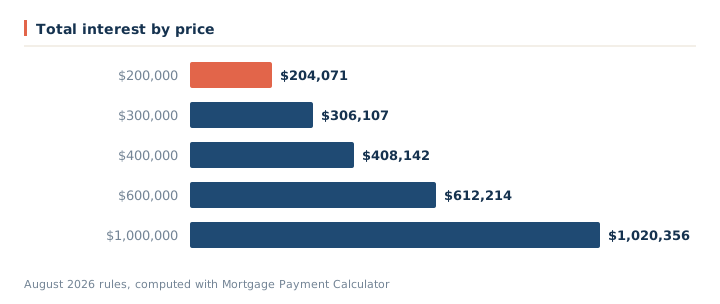
We ran 5 values of price through the calculator and left every other input at its default. As of August 2026, the output was:
| Price ($) | Total interest ($) | Total monthly payment ($) | Principal and interest ($) |
|---|---|---|---|
| 200,000 | 204,071.18 | 1,561.31 | 1,011.31 |
| 300,000 | 306,106.77 | 2,066.96 | 1,516.96 |
| 400,000 | 408,142.36 | 2,572.62 | 2,022.62 |
| 600,000 | 612,213.54 | 3,583.93 | 3,033.93 |
| 1,000,000 | 1,020,355.91 | 5,606.54 | 5,056.54 |
Running price from $200,000 up to $1,000,000 moves total interest from $204,071 to $1,020,356 — a spread of $816,285. That gap is the part a single headline rate never shows.
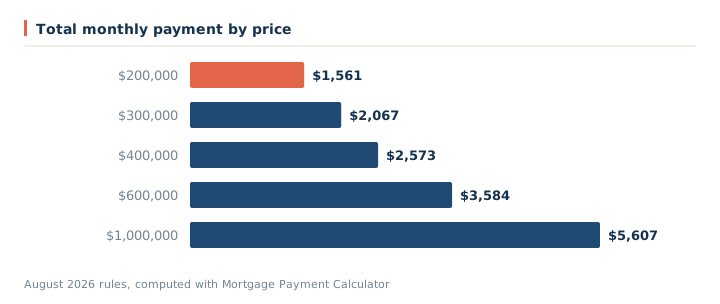
The same runs seen through total monthly payment
At $200,000, total monthly payment works out to $1,561; at $1,000,000 it is $5,607. Looking only at total interest tends to understate how much the outcome shifts across that range.
Assumptions behind these figures
| Input | Value |
|---|---|
| Price | $400,000 |
| Down payment percent | 20% |
| Rate | 6.5% |
| Term | 30 years |
| Property tax annual | $4,800 |
| Insurance annual | $1,800 |
| As of | August 2026 |
| Method | identical to /tools/mortgage-payment-calculator |
Brackets, thresholds and rates change from year to year, so treat these as August 2026 figures for the 2026 tax year. For your own situation, open the Mortgage Payment Calculator and enter your real numbers — the calculator runs the same code that produced every figure on this page.