You saved the down payment, you got approved, you found the house, and then a form arrives saying you owe several thousand dollars more just to finish. Closing costs are the most common unpleasant surprise in buying, not because they are hidden, but because almost nobody learns what they are until the bill is in their hands.
They are not one fee. They are a stack of separate charges from four different sources, and the most useful thing you can know is which parts of the stack will move if you push and which will not.
How big, and when you will see it
Closing costs typically run 2% to 5% of the loan, which on a $300,000 loan is roughly $6,000 to $15,000. The range swings widely by state, lender, and loan type, so it belongs in your savings plan from the start, not as an afterthought. You will see the number twice as standardized documents: the Loan Estimate within three business days of applying, which is your comparison tool across lenders, and the Closing Disclosure at least three business days before closing, which you compare line by line against the Loan Estimate. Those two forms are not bureaucracy for its own sake; they were standardized precisely so an ordinary buyer could lay two lenders' offers side by side and see who padded what, which is leverage most people never use because they did not know the page was built to give it to them. Some figures are legally not allowed to rise, so an unexplained jump is a question to ask, not a number to swallow. Estimate yours early with the Closing Cost Calculator so it is never a shock.
The four buckets
| Bucket | Examples | Negotiable? |
|---|---|---|
| Lender / origination | Origination, underwriting, points | Often yes |
| Third-party services | Appraisal, title, settlement | Often shoppable |
| Government | Recording fees, transfer taxes | No |
| Prepaids / escrow | Prepaid interest, tax & insurance reserves | No, but timing-sensitive |
Lender fees are the lender's charge to create the loan, and they are among the most negotiable. Third-party services are required but you can frequently choose the provider, and quotes for the same title or settlement work differ by hundreds of dollars. Government charges, recording fees and transfer taxes, are essentially fixed, and in some jurisdictions the transfer tax is the single largest line on the page. Prepaids are not really fees at all; they are future expenses, interest and an escrow cushion for taxes and insurance, collected up front.
One realistic page, itemized
Generic ranges do not prepare you for the shape of the actual bill, so here is a representative $300,000 purchase with a $285,000 loan. Your numbers will differ by state and lender, but the proportions are typical and worth recognizing on sight:
| Line | Bucket | Typical amount |
|---|---|---|
| Origination / underwriting | Lender | $1,400 |
| One discount point (optional) | Lender | $2,850 |
| Appraisal | Third-party | $600 |
| Lender's title insurance | Third-party | $900 |
| Owner's title insurance | Third-party | $1,200 |
| Settlement / closing fee | Third-party | $700 |
| Recording fee | Government | $150 |
| Transfer / stamp tax | Government | $2,400 |
| Prepaid interest (partial month) | Prepaid | $600 |
| Homeowners insurance (1 year) | Prepaid | $1,400 |
| Tax & insurance escrow reserve | Prepaid | $1,800 |
| Total | ~$14,400 |
Notice where the money actually is. The two largest lines are usually the optional discount point and the government transfer tax, and they sit at opposite ends of the negotiability spectrum: one is entirely your choice, the other is entirely fixed. The prepaids near the bottom feel like fees but are simply your own future expenses paid early; you would owe that insurance and interest anyway. Strip out the optional point and the unavoidable government and prepaid lines, and the genuinely contestable portion of this $14,400 is closer to $5,000 to $6,000. That is the money your effort can actually move, and knowing which lines those are is most of the skill.
What is legally allowed to change, and what is not
The two forms are not just paperwork; they come with rules that hand you leverage if you know them. Charges fall into tolerance categories. Some lender fees have zero tolerance, meaning the figure on your Loan Estimate cannot increase at all by closing unless something material about the loan changes. Others sit in a 10% bucket, where the total of that group may rise by no more than ten percent. A third group can vary freely because they depend on outside choices or events. The practical consequence is direct: if a zero-tolerance line is higher on the Closing Disclosure than it was on the Loan Estimate, that is not a fee to accept quietly, it is an error the lender generally must cure. Reading the two documents side by side, line against line, is not bureaucratic diligence; it is the moment the law is actually working in your favor, and it only works if you look.
A worked example: the seller credit beats the price cut
Buyers instinctively negotiate the price and ignore the closing table, which often leaves money behind. Compare two offers on the same $300,000 home. In the first you negotiate the price down to $295,000. In the second you keep the price at $300,000 but ask the seller for a $5,000 closing-cost credit. The $5,000 price cut lowers your loan by $5,000 and saves you, at 6.5% over 30 years, about $32 a month, real but slow. The $5,000 credit instead removes $5,000 of cash you need on closing day, money you keep right now, which for a cash-constrained buyer is far more useful than $32 a month arriving over three decades. In a buyer-friendly market, asking for the credit rather than only the price cut can be the single highest-value move on the page, and it costs nothing to request.
A worked example: points are a break-even, not a discount
A discount point is prepaid interest, roughly 1% of the loan to lower the rate a fraction. On a $285,000 loan one point is about $2,850 and might cut the payment by $45 a month. Divide $2,850 by $45 and the point pays for itself in about 63 months, a little over five years. Keep the loan well beyond that and the point was a good purchase; sell or refinance before it and you simply spent $2,850 to save less than $2,850. Lender credits run the same arithmetic in reverse: you accept a slightly higher rate so the lender pays some of your closing costs, which is sensible only if you will move or refinance before the higher rate eats the upfront relief. Points are not a discount and credits are not free money; both are timing bets, and the break-even month is the only number that tells you which way to take the bet.
Seven ways to pay less, in order of payoff
The largest lever is comparing lenders by APR rather than rate, the same day, so the form forces the padding into the open. Close behind it is negotiating a seller credit, asking the seller in your offer to cover part of closing, which in a buyer-friendly market converts a price fight into cash at the table. Shop the third-party services you are allowed to choose, because the lender's preferred vendor is rarely the cheapest. Consider lender credits, the mirror image of points, accepting a slightly higher rate in exchange for a credit that lowers cash needed now, sensible only if you will move or refinance before the higher rate eats the savings. Time the closing later in the month to reduce prepaid daily interest. Check whether a first-time-buyer or assistance program covers closing costs, which can erase a large chunk outright. And finally, audit the Closing Disclosure against the Loan Estimate, because errors and padding are real and you have a legal window to question them.
The escrow reserve feels like a fee and is not one
The line that confuses buyers most is the escrow reserve, often one of the larger numbers on the page, because it looks like a charge and it is not. The lender is collecting a few months of property taxes and homeowners insurance up front so the escrow account has a cushion before the first bills come due. That money is yours; it pays your taxes and your insurance, expenses you would owe whether or not a lender existed. Understanding this changes how you read the bottom line. When you compare two lenders, the reserve is not a fee to shop, it is roughly the same obligation either way and reflects your closing date and local tax calendar more than the lender's pricing. The fees to attack are the lender and shoppable third-party lines; the reserve is your own future money parked early. Confusing the two leads people either to panic at a total that includes their own taxes or to "save" by choosing a lender who simply collected a thinner cushion, which they make up later. Read the reserve as prepaid you, not as profit them.
Rolling costs into the loan, with the real number attached
When cash is tight the lender will often offer to fold closing costs into the loan or into a slightly higher rate, and it sounds like relief. Price it before you accept. Roll $9,000 of costs into a $285,000 loan at 6.5% over 30 years and you do not pay $9,000, you pay interest on $9,000 for up to three decades, which can total well over $11,000 by the time the loan is gone. That can still be the correct choice; if rolling the costs in is the difference between buying a home that builds equity for thirty years and not buying at all, the extra interest is a price worth paying and you should pay it without guilt. The error is not rolling costs in; the error is doing it because it felt free. Run it through the Mortgage Payment Calculator both ways, see the lifetime difference in actual dollars, and then choose. A decision made with the number visible is fine. A decision made because the cash version was uncomfortable is how people pay thousands they never saw.
Why your neighbor paid half what someone else did
Two buyers with nearly identical loans can see closing totals thousands of dollars apart, and it is rarely because one negotiated harder. State and county practice dominates. Transfer or stamp taxes range from nonexistent in some states to a four-figure line in others on the same price. Some states use attorneys for closings, others use title companies, with different fee structures. Whether the buyer or seller customarily pays owner's title insurance varies by region and even by county. None of this is in your control, which is the point: do not benchmark your bill against a friend who bought in another state and conclude you are being overcharged, and do not assume a low-tax purchase price in a high-transfer-tax state is the bargain it looks like. Compare your Loan Estimate against other lenders' estimates for the same property, not against anecdotes from a different jurisdiction.
The day the Closing Disclosure arrives
Treat its delivery as a task with a deadline, not a notification. Lay it next to your most recent Loan Estimate and move down line by line. Confirm the zero-tolerance lender fees did not rise. Total the 10% bucket and check it stayed within bounds. Verify the loan amount, rate, term, and monthly payment match what you agreed to, not a number that drifted. Make sure any seller credit you negotiated actually appears. Question anything new, larger, or unexplained, in writing, before you sign rather than after. You have a legally protected window between receiving this document and closing precisely so this review can happen; using it is the difference between catching a $700 error and paying it for the rest of the loan.
Be realistic about what will not move
Spending an afternoon arguing with the county over a recording fee is wasted energy. Government charges, transfer taxes, and the appraisal cost itself are close to fixed. The savings live almost entirely in two buckets, lender fees and shoppable third-party services, so concentrate your effort there and let the fixed costs be fixed.
One question worth answering before you decide to roll costs into the loan to preserve cash: doing so means paying interest on those costs for the life of the loan. It can be the right call when cash is genuinely tight, but model it in the Mortgage Payment Calculator first so you are choosing it with eyes open rather than relief. Closing costs are knowable, partly negotiable, and never a reason to be ambushed. Treat the Loan Estimate as the moment you take control, not the moment you find out.
Run the numbers
Everything below came out of this site's own Mortgage Payment Calculator. The figures are not quoted from anywhere else: each row is one run of the same calculation the tool page performs, using August 2026 rules. Put the same inputs in and you will get the same output.
How the result moves with price
We ran 5 values of price through the calculator and left every other input at its default. As of August 2026, the output was:
| Price ($) | Total interest ($) | Total monthly payment ($) | Principal and interest ($) |
|---|---|---|---|
| 200,000 | 204,071.18 | 1,561.31 | 1,011.31 |
| 300,000 | 306,106.77 | 2,066.96 | 1,516.96 |
| 400,000 | 408,142.36 | 2,572.62 | 2,022.62 |
| 600,000 | 612,213.54 | 3,583.93 | 3,033.93 |
| 1,000,000 | 1,020,355.91 | 5,606.54 | 5,056.54 |
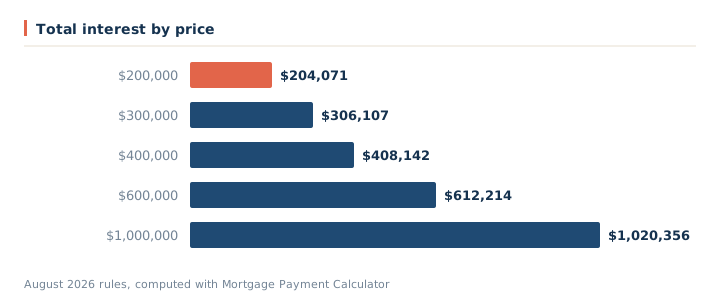
Running price from $200,000 up to $1,000,000 moves total interest from $204,071 to $1,020,356 — a spread of $816,285. That gap is the part a single headline rate never shows.
The same runs seen through total monthly payment
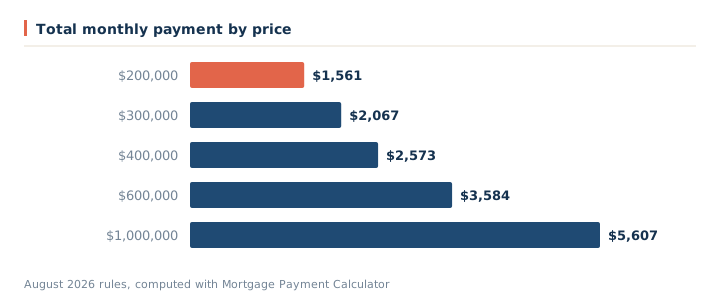
At $200,000, total monthly payment works out to $1,561; at $1,000,000 it is $5,607. Looking only at total interest tends to understate how much the outcome shifts across that range.
Assumptions behind these figures
| Input | Value |
|---|---|
| Price | $400,000 |
| Down payment percent | 20% |
| Rate | 6.5% |
| Term | 30 years |
| Property tax annual | $4,800 |
| Insurance annual | $1,800 |
| As of | August 2026 |
| Method | identical to /tools/mortgage-payment-calculator |
Brackets, thresholds and rates change from year to year, so treat these as August 2026 figures for the 2026 tax year. For your own situation, open the Mortgage Payment Calculator and enter your real numbers — the calculator runs the same code that produced every figure on this page.