"Renting is throwing money away" is the most repeated line in personal finance, and it is not an argument. It is a slogan that quietly ignores half the equation. Buying can absolutely build wealth. It can also be the worse decision if your horizon is short or the local math is unfavorable. The honest answer needs the full cost of each path, including the parts each side conveniently forgets.
Why the slogan is wrong in both directions
Rent is no more "thrown away" than mortgage interest, property tax, and insurance, all of which are also unrecoverable. And a mortgage payment is not all equity; early on, most of it is interest and escrow. Both housing choices have a real, unrecoverable cost. The only question worth asking is which unrecoverable cost is lower for your situation and your time horizon, and the answer is genuinely different for different people in different markets at different stages of life, which is precisely why a one-line slogan cannot carry it.
The true cost of buying
Buyers routinely compare a future mortgage payment to today's rent and conclude buying is cheaper. That comparison is incomplete. The real cost of owning includes the interest portion of the payment, property taxes that tend to rise, homeowners insurance, mortgage insurance if you put down less than 20%, maintenance at a common planning figure of roughly 1% of value per year, transaction costs to buy and again to sell, and the opportunity cost of the down payment that is no longer invested. The last two are the ones buyers almost always omit, and they are exactly why the time horizon decides the outcome.
The true cost of renting
Renting has its own honest ledger: rent plus expected annual increases, renter's insurance, and the genuine loss of any appreciation and forced savings. Against that sit real benefits, full flexibility, zero maintenance cost, no transaction costs to leave, and a down payment that stays invested and liquid. Renting is not waste. It is buying flexibility and avoiding large transaction costs while giving up forced savings and appreciation.
One five-year ledger, both columns filled honestly
Slogans collapse the moment you total both columns over a real horizon. Take a $350,000 home, 10% down, against renting a comparable place for $2,100 a month, over five years.
| Cost over 5 years | Buy | Rent |
|---|---|---|
| Mortgage interest (most of early payments) | ~$98,000 | — |
| Property tax + insurance | ~$30,000 | — |
| Maintenance (~1%/yr) | ~$18,000 | — |
| Buy + sell transaction costs | ~$28,000 | — |
| Rent (with ~3%/yr increases) | — | ~$134,000 |
| Renter's insurance | — | ~$1,500 |
| Opportunity cost of $35,000 down payment | counted as tied up | stays invested |
| Roughly unrecoverable | ~$174,000 | ~$135,500 |
At five years in this illustration renting is cheaper on unrecoverable cost, even before crediting the renter for an invested down payment, because the buyer's transaction costs have not yet amortized and early payments are mostly interest. Push the same scenario to ten or twelve years and the buy column flattens, the transaction costs spread thin, and equity plus appreciation flip the result. The numbers are illustrative and your market will differ, which is exactly the point: the honest comparison is total unrecoverable cost over your specific horizon, run with your local rent, price, and rates in the Rent vs Buy Calculator, not a slogan applied to everyone.
The price-to-rent ratio: a thirty-second sanity check
Before any detailed model, one quick number tells you which way the local wind blows: divide a home's price by a comparable property's annual rent. A low ratio, very roughly under 15, means buying tends to look favorable in that market; a high ratio, very roughly over 20, means renting often wins unless you stay a long time. It is a screen, not a verdict, because it ignores your horizon, your rate, and local appreciation, but it instantly flags when "everyone should buy" or "renting is always smarter" is locally absurd. A high price-to-rent city can make a perfectly responsible buyer better off renting and investing the difference, and a low one can make lifelong renters poorer than neighbors who bought. The ratio does not decide; it tells you how hard the rest of the math has to work.
The two numbers buyers almost always omit
When buying loses to renting on an honest ledger, it is usually because of two costs buyers mentally set to zero. The first is transaction cost. Buying a home incurs closing costs going in, and selling it incurs agent commissions and more closing costs going out; together these commonly run a meaningful share of the home's value, and they are pure, unrecoverable friction. Spread across two years they can exceed all the equity you built. Spread across twelve they nearly vanish per year. This single fact is most of why the horizon decides everything. The second omission is maintenance. The roughly 1%-of-value-per-year planning figure is not a worst case; it is an average that arrives lumpy, a quiet decade followed by a roof, an HVAC system, and a water heater in the same eighteen months. A renter's equivalent of all of this is a phone call to a landlord. Leave these two out, as buyers instinctively do when comparing a future mortgage payment to today's rent, and ownership always looks cheaper than it is. Put them in and the comparison becomes honest, which is the only state in which it is worth trusting.
Renting is a service you are buying, not a failure
It helps to reframe what renting actually purchases, because the slogan frames it as throwing money away and that distorts the decision. Rent buys a defined, unrecoverable cost in exchange for total mobility, zero maintenance exposure, no transaction costs on either end, and a down payment that stays liquid and invested. Those are not consolation prizes; for someone whose career, family situation, or location is genuinely unsettled, mobility alone can be worth more than several years of equity, and avoiding a six-figure transaction round-trip on a short stay is a concrete financial win, not a moral compromise. The correct question is never whether renting "wastes" money, because every housing choice has an unrecoverable cost. It is which unrecoverable cost buys the package that fits the life you are actually living over the horizon you can actually defend.
The variable that overwhelms the rest
| Expected stay | Tendency | Why |
|---|---|---|
| Under ~3 years | Renting usually wins | Transaction costs not amortized |
| ~3–6 years | Highly situational | Local prices, rents, rates decide |
| Over ~6–7 years | Buying usually wins | Costs amortized, equity and appreciation compound |
Buying carries big one-time costs at both ends. Spread over two years they are crushing per year; spread over twelve they are minor while equity and appreciation accumulate. This is why the same house and the same rent can favor renting or buying purely on how long you stay. These bands are rules of thumb, not laws; the Rent vs Buy Calculator computes your personal break-even from real inputs, and the Mortgage Affordability Calculator confirms what you could responsibly buy in the first place.
"Just invest the difference" is true on paper and rare in practice
The strongest argument for renting is that the down payment and the monthly difference, invested consistently, can outperform home equity, especially in a high price-to-rent market. On a spreadsheet this is often correct. The honest footnote is behavioral: most people do not actually invest the difference. They spend some of it, and the home quietly becomes a forced savings account that builds equity precisely because the payment is not optional. So the rent-and-invest case is mathematically sound and conditionally real. If you will genuinely automate the investment and leave it alone, renting can build more wealth in the right market. If "invest the difference" is an intention rather than a standing order you have actually set up, buying's involuntary savings may beat your real behavior even when it loses to your theoretical behavior. Be ruthless about which person you are; this single piece of self-knowledge swings the answer more than the interest rate does.
The leverage nobody mentions out loud
There is a quiet financial reason buying can outperform in a rising market, and it is leverage, not magic. Put 10% down on a $350,000 home and a 4% rise in the home's value is roughly a 40% return on your cash, because appreciation accrues on the whole house while you only funded a slice of it. That cuts both ways: in a falling market the same leverage magnifies the loss, and a short holding period turns transaction costs into a near-guaranteed one. This is why the time horizon dominates everything. Leverage plus time plus a rising market is how ordinary owners build six-figure equity; leverage plus a short stay plus soft prices is how buyers lose money on a home that "always goes up." Renting has no leverage and therefore neither the upside nor the trap. Choosing between them is partly choosing whether you want, and can stomach, that amplification.
Three markets, three different right answers
| Market shape | Tendency | Why |
|---|---|---|
| High price-to-rent, flat prices, short stay | Rent and invest | Buying's costs never amortize; cash compounds elsewhere |
| Moderate ratio, steady appreciation, long stay | Buy | Leverage and time turn equity and appreciation into real wealth |
| Low price-to-rent, rising rents, stable life | Buy decisively | Owning is near or below renting from early on, then pulls far ahead |
Notice none of the rows is a moral statement; each is the same comparison resolving differently because the inputs differ. The same family relocated across these three markets could correctly rent in one city and buy in the next without changing a single value about themselves. Anyone who gives you a universal answer is describing their market, or their slogan, not your decision.
The part the math cannot capture
Money is not the only input, and pretending otherwise is its own mistake. Owning roots you and lets you renovate but hands you every repair and its cost in time. Renting lets you move for a job cheaply but gives you no control and no forced savings. A reasonable rule: if the math is close, let lifestyle break the tie; if the math is lopsided, respect it. Renting is the smart financial choice when you may move within a few years, when local prices are very high relative to rents, when buying would empty your emergency fund, or when you will genuinely invest the difference. Buying is the smart choice when you will stay past the break-even horizon, the local math is favorable, you want forced savings and a stable payment, and you can buy without wrecking your liquidity. The decision is not moral and it is not a slogan. It is a comparison of total unrecoverable cost over your horizon, run with your numbers, with lifestyle as the tiebreaker, not the headline.
The order to actually decide in
Run it in four moves and the answer tends to reveal itself. First, state your honest horizon, not your hope but the period you can defend, because under roughly three years the math rarely favors buying regardless of anything else. Second, take the local price-to-rent screen to see whether your market even makes buying competitive before you model anything. Third, build both ledgers with your real local rent, price trend, rate, and the down payment's opportunity cost in the Rent vs Buy Calculator, and confirm with the Mortgage Affordability Calculator that the purchase would not wreck your liquidity in the first place. Fourth, and only fourth, let lifestyle weigh in, as the tiebreaker when the numbers are close and as a constraint, never an override, when they are not. Done in that order the question stops being an argument you have with a slogan and becomes a calculation with a defensible answer, which is the only kind worth trusting on a decision this large. And if, after running it honestly, the numbers are genuinely close, that is not a failure of the analysis; it is the analysis telling you this is finally the rare case where lifestyle is allowed to decide, because the financial cost of choosing either way is small enough that the life you want to live is the deciding factor it almost never gets to be. That outcome is not the math failing to answer; it is the math doing its most useful job, telling you exactly when you are free to stop optimizing and simply choose the home, or the freedom, you actually want.
Run the numbers
Everything below came out of this site's own Mortgage Affordability Calculator. The figures are not quoted from anywhere else: each row is one run of the same calculation the tool page performs, using August 2026 rules. Put the same inputs in and you will get the same output.
How the result moves with income
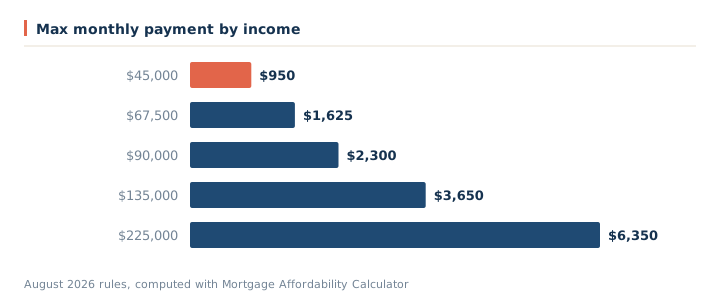
We ran 5 values of income through the calculator and left every other input at its default. As of August 2026, the output was:
| Income ($) | Max monthly payment ($) | Loan amount ($) | Home price affordable ($) |
|---|---|---|---|
| 45,000 | 950 | 150,300.28 | 210,300.28 |
| 67,500 | 1,625 | 257,092.58 | 317,092.58 |
| 90,000 | 2,300 | 363,884.88 | 423,884.88 |
| 135,000 | 3,650 | 577,469.49 | 637,469.49 |
| 225,000 | 6,350 | 1,004,638.7 | 1,064,638.7 |
Running income from $45,000 up to $225,000 moves max monthly payment from $950 to $6,350 — a spread of $5,400. That gap is the part a single headline rate never shows.
The same runs seen through loan amount
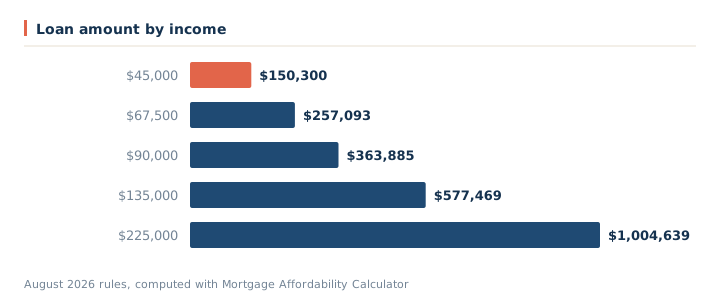
At $45,000, loan amount works out to $150,300; at $225,000 it is $1,004,639. Looking only at max monthly payment tends to understate how much the outcome shifts across that range.
Assumptions behind these figures
| Input | Value |
|---|---|
| Income | $90,000 |
| Monthly debts | $400 |
| Down payment | $60,000 |
| Rate | 6.5% |
| Term | 30 years |
| As of | August 2026 |
| Method | identical to /tools/mortgage-affordability-calculator |
Brackets, thresholds and rates change from year to year, so treat these as August 2026 figures for the 2026 tax year. For your own situation, open the Mortgage Affordability Calculator and enter your real numbers — the calculator runs the same code that produced every figure on this page.