For most buyers who are not eligible for a VA or USDA loan, the real fork in the road is FHA versus conventional. They are engineered for different borrowers, and choosing the one that does not fit your profile usually costs you, mostly through mortgage insurance rather than the headline rate.
The core difference, stated plainly
A conventional loan rewards financial strength. Better credit and a larger down payment unlock better terms and, crucially, mortgage insurance that you can eventually cancel. An FHA loan trades higher long-term insurance cost for easier entry: it is friendlier to lower credit scores, smaller down payments, and higher debt-to-income ratios. Neither is "better." One is built to approve more people; the other is built to reward people the system already approves easily.
| Factor | FHA | Conventional |
|---|---|---|
| Minimum down | 3.5% | 3% |
| Credit | Forgiving of lower scores | Rewards strong credit |
| Mortgage insurance | MIP, often life-of-loan | PMI, removable near 20% equity |
| Upfront insurance | Yes, financed | None |
| Best for | Thinner or bruised credit | Strong credit, path to 20% |
The one factor that decides most of it
Almost the entire long-term cost difference comes down to how the mortgage insurance behaves. FHA loans carry an upfront premium plus an annual one, and on many low-down FHA loans the annual MIP lasts the entire life of the loan. You cannot simply reach 20% equity and cancel it; the standard exit is refinancing into a conventional loan. Conventional PMI is the opposite. By law, on a primary residence, you can request cancellation near 80% loan-to-value and the lender must drop it automatically at 78%. PMI is also priced heavily on credit, so a strong-credit borrower often pays less for removable PMI than they would for permanent MIP. Estimate either with the PMI Calculator.
The implication is the headline most comparisons bury: over a long hold with decent credit, conventional frequently becomes meaningfully cheaper specifically because the insurance ends while FHA's keeps running.
Credit score is priced very differently on each loan
The two programs do not just have different rules; they price the same borrower differently, and this is where the choice is often decided before anyone runs a payment. Conventional PMI is risk-priced steeply on your credit score, so a borrower in the mid-700s might pay a fraction of what a borrower in the low-600s pays for the identical loan, and at the top of the range PMI can be modest enough that the "FHA is for lower scores" intuition flips entirely. FHA mortgage insurance is comparatively flat across credit bands; it does not reward a strong score the way conventional does. The honest reading is a crossover. Below a certain credit band, FHA's forgiving underwriting and flat insurance make it the realistic, sometimes only, path. Above that band, conventional's credit-sensitive, cancellable PMI usually makes it the cheaper loan, often by a wide margin over a long hold. The fork is less "which program is better" and more "which side of the credit crossover are you on."
Loan limits, property condition, and the parts nobody mentions
The insurance is the headline difference but not the only one that can decide a specific purchase. FHA loans carry county loan limits that can be restrictive in higher-cost areas, where conventional financing simply reaches further. FHA also requires the property to meet minimum condition standards through its appraisal, which protects you from buying a hazardous home but can make a fixer or an as-is sale harder to close than with conventional financing. Conventional underwriting tends to scrutinize the borrower's profile harder; FHA tends to scrutinize the property harder. On a pristine home with a thin borrower file, FHA's tradeoff is favorable. On a rough property with a strong borrower, conventional's is. The "better loan" can change purely with the house you are trying to buy, which is why a generic ranking is useless without the specifics.
A real-numbers scenario
Same $300,000 home, 30-year term, good-not-excellent credit. FHA at 3.5% down means a lower entry barrier but mortgage insurance that, in many cases, never stops without a refinance. Conventional at 5% down means a slightly larger down payment and PMI around $150 a month that you can cancel once you reach roughly 20% equity. Short term, FHA is often easier to get into. Past year ten, conventional is frequently the cheaper loan because its insurance has long since disappeared while FHA's has not. Run your exact figures through the Mortgage Payment Calculator before deciding, because the crossover point depends on your numbers.
Trace the money over ten years
Watch the same two loans across a decade instead of a snapshot. The FHA path costs less cash on day one, the smaller down payment, but adds an upfront insurance premium financed into the balance and then an annual MIP that, on this low-down loan, simply keeps running, call it roughly $175 a month that never stops on its own. Across ten years that is about $21,000 in insurance with no end in sight. The conventional path costs slightly more up front and carries about $150 a month in PMI, but the borrower reaches the cancellation threshold somewhere around year seven or eight through payments and modest appreciation, after which that line goes to zero. Over the same decade conventional pays perhaps $13,000–$14,000 in PMI and then nothing, while FHA is still paying and will be paying in year fifteen. The gap is not the rate; the rates may be within a hair of each other. The gap is an insurance line that ends versus one that does not, and ten years is long enough for it to become the whole story.
When the refinance-out plan is the real plan
Many FHA borrowers intend to refinance into a conventional loan once their credit and equity improve, shedding the life-of-loan MIP. It is a legitimate strategy, and it is also a future transaction with its own closing costs and three preconditions that must all hold years from now: rates low enough to make refinancing worthwhile, credit strong enough to qualify conventional, and an appraisal high enough to clear 20% equity. Price it honestly. The refinance will cost 2% to 5% of the balance, and if rates have risen by the time you are eligible, the conventional loan that finally cancels your MIP may carry a payment that erases the saving. The strategy works often enough to be worth planning for, but the FHA loan has to be acceptable on its own terms in case the refinance arrives late or never. Treat the refinance as an option you hope to exercise, not a cost you have already avoided.
Match the loan to your actual profile
Set the slogans aside and locate yourself in the table; this decision is profile-driven, not preference-driven:
| Your situation | Likely better fit | Why |
|---|---|---|
| Credit in the low-to-mid 600s, thin or bruised file | FHA | Flexible underwriting; flat insurance does not punish the score |
| Higher debt-to-income, needs the approval | FHA | More forgiving DTI tolerance gets you qualified at all |
| Strong credit, clear path to 20% equity, long hold | Conventional | Credit-priced PMI is cheap and, crucially, ends |
| Buying in a high-cost area above FHA limits | Conventional | Reaches the loan size FHA's county cap will not |
| Rough or as-is property | Often conventional | FHA condition standards can block the deal |
| Imperfect credit now, realistic refinance plan later | FHA, then refinance | Access now, with conventional as the planned exit |
The pattern across every row is the same: FHA sells access, conventional sells an insurance cost that disappears. If access is your binding constraint, FHA earns its keep. If you already have access, you are usually paying FHA for a flexibility you do not need.
Find your own crossover before you choose
The whole comparison reduces to one question with a personal answer: at what month does conventional's vanishing insurance overtake FHA's lower entry cost for you specifically? You can locate it without a spreadsheet. Estimate the FHA path's lifetime, the smaller down payment plus the financed upfront premium plus the annual MIP that does not stop, and estimate the conventional path's, the slightly larger down payment plus PMI that ends roughly when payments and appreciation carry you to about 20% equity, often somewhere around year seven or eight on a low-down loan. The crossover is the month the running totals cross, and your holding period is the answer key. Plan to be gone before the crossover and FHA's easier, cheaper entry wins outright. Plan to stay well past it and conventional is the cheaper loan by a margin that widens every year the FHA insurance keeps running. Put your real down payment, rate, and credit-priced PMI into the Mortgage Payment Calculator, compare it against the FHA structure, and let the crossover month, not a generic verdict, make the call. The reason no article can simply tell you which loan is better is that the honest answer is a date, and the date is yours.
The debt-to-income angle people overlook
There is a quiet reason FHA approves buyers conventional turns away, and it is not only the credit score. FHA generally tolerates higher debt-to-income ratios, so a borrower whose student loans and car payment push them past conventional's comfort line can still be approved. That flexibility is genuinely valuable when it is the difference between buying and not buying. It is also worth a sober second thought: a loan that approves you at a higher debt load has not made the debt load safer, it has only made it permissible. The right use of FHA's leniency is to buy a home you can comfortably carry that conventional underwriting was too rigid to see; the wrong use is to buy at the very edge of what FHA will allow and call the approval proof you can afford it. The underwriting standard and your real budget are not the same test, and only one of them sends you the bill every month.
Picking your side
FHA earns its place when your credit score sits below conventional comfort, your file is thin or recently bruised, your debt-to-income is on the high side, or you simply need the more flexible underwriting to be approved at all. Its value is access, and access is worth a great deal if the alternative is not buying.
Conventional wins when your credit is good to excellent, you can keep PMI modest and have a realistic path to 20% equity, and you will hold the home long enough for cancellation to pay off. For strong-credit buyers planning to stay, the removable insurance is the whole game.
One more practical point separates the two in real underwriting: the documents and the timeline. FHA's flexibility comes with its own paperwork and a property that must clear condition standards, which can lengthen a purchase or narrow which homes qualify. Conventional underwriting moves faster on a strong file and a clean property but is less forgiving when either is shaky. Neither is a dealbreaker, but on a competitive offer the loan that closes more predictably for your specific file and your specific house is itself worth something, and it does not always match the loan that looks cheaper on a spreadsheet. Factor closing certainty into the choice, not just lifetime cost.
There is a legitimate hybrid: buy with FHA now because your credit is imperfect, then refinance into a conventional loan once your score and equity improve to shed the life-of-loan MIP. It works, but treat it as a plan with risk, not a guarantee, because it depends on future rates, your future credit, and home values. The FHA loan needs to be acceptable on its own terms in case the refinance does not arrive on schedule. Choose based on your credit profile and how long you will stay, not on which loan sounds generically superior, because for this decision there is no generically superior answer. The borrower who picks FHA with a clear-eyed plan to refinance, and the borrower who picks conventional because the math says stay, can both be making the optimal choice on the same street in the same week. What they share is not the loan; it is that each one located their own crossover instead of borrowing a stranger's conclusion.
Run the numbers
Everything below came out of this site's own Mortgage Payment Calculator. The figures are not quoted from anywhere else: each row is one run of the same calculation the tool page performs, using August 2026 rules. Put the same inputs in and you will get the same output.
How the result moves with price
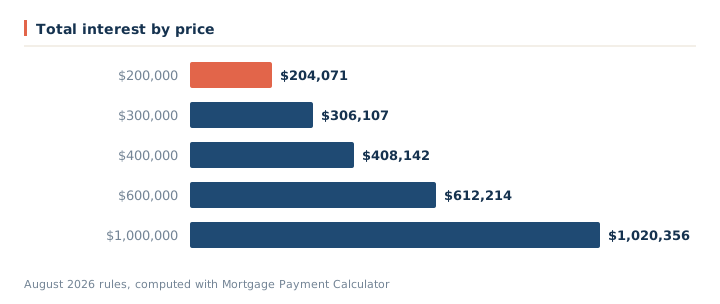
We ran 5 values of price through the calculator and left every other input at its default. As of August 2026, the output was:
| Price ($) | Total interest ($) | Total monthly payment ($) | Principal and interest ($) |
|---|---|---|---|
| 200,000 | 204,071.18 | 1,561.31 | 1,011.31 |
| 300,000 | 306,106.77 | 2,066.96 | 1,516.96 |
| 400,000 | 408,142.36 | 2,572.62 | 2,022.62 |
| 600,000 | 612,213.54 | 3,583.93 | 3,033.93 |
| 1,000,000 | 1,020,355.91 | 5,606.54 | 5,056.54 |
Running price from $200,000 up to $1,000,000 moves total interest from $204,071 to $1,020,356 — a spread of $816,285. That gap is the part a single headline rate never shows.
The same runs seen through total monthly payment
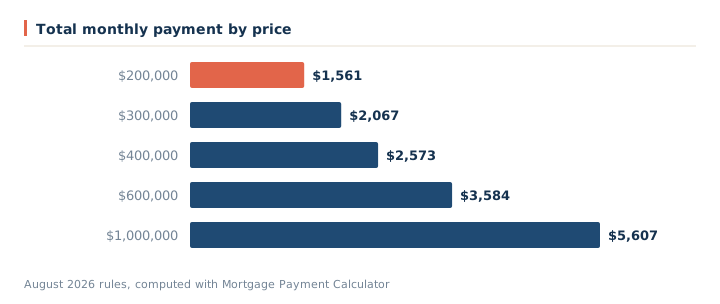
At $200,000, total monthly payment works out to $1,561; at $1,000,000 it is $5,607. Looking only at total interest tends to understate how much the outcome shifts across that range.
Assumptions behind these figures
| Input | Value |
|---|---|
| Price | $400,000 |
| Down payment percent | 20% |
| Rate | 6.5% |
| Term | 30 years |
| Property tax annual | $4,800 |
| Insurance annual | $1,800 |
| As of | August 2026 |
| Method | identical to /tools/mortgage-payment-calculator |
Brackets, thresholds and rates change from year to year, so treat these as August 2026 figures for the 2026 tax year. For your own situation, open the Mortgage Payment Calculator and enter your real numbers — the calculator runs the same code that produced every figure on this page.