The loan term is usually decided in about five seconds, somewhere near the bottom of a form, with far less thought than people give to picking a paint color. On a normal loan it is a quarter-of-a-million-dollar decision.
There is no single answer that is right for everyone, and anyone who tells you the 15-year is simply and universally "better" is selling a slogan rather than doing the math. There is an answer that is right for you, and it becomes clear once the numbers and the trade-offs are on the table together.
The whole tension in one line
A 30-year loan minimizes your monthly payment. A 15-year loan minimizes your total cost. Every argument below is just a consequence of that single sentence pulling in two directions.
Put real numbers on it
Take a $350,000 loan. Fifteen-year loans almost always price below 30-year loans, so use a realistic spread: 6.75% for thirty years, 6.00% for fifteen.
| 30-year @ 6.75% | 15-year @ 6.00% | |
|---|---|---|
| Monthly principal & interest | ~$2,270 | ~$2,953 |
| Total paid over the loan | ~$817,200 | ~$531,500 |
| Total interest | ~$467,200 | ~$181,500 |
| Years until debt-free | 30 | 15 |
The 15-year costs about $683 more a month. In exchange it saves roughly $285,700 in interest and ends fifteen years sooner. That number is not a typo, and it is not unusual. Run your own price and rates through the Mortgage Payment Calculator and you will see a similarly enormous gap, because the gap is structural, not specific to this example.
If the comparison ended there, everyone would take the 15-year. It does not end there, because money has timing and flexibility has value.
Four dimensions, not one
Total interest is the loudest number, but a good decision weighs four things.
The first is cash flow. The 30-year's lower required payment is a form of insurance you are buying. If income drops, a medical bill lands, or an opportunity appears, the lower obligation is room to maneuver. The 15-year demands the higher payment in your worst month exactly as much as your best one.
The second is equity speed. The 15-year builds ownership startlingly fast because principal dominates the payment from the first month. That matters if you want to drop PMI quickly, borrow against equity, or sell within a decade with real proceeds in hand.
The third is the retirement clock. Being mortgage-free at fifty instead of sixty-five is not a rounding error in a financial life; it is a different retirement. The 15-year converts present cash flow into a debt-free future. The 30-year preserves present cash flow and carries the obligation much longer.
The fourth is the one people argue about most, so it gets its own section.
Watch the equity gap open
Total interest is the headline, but the speed at which you actually own the house is its own argument, and it is dramatic early. On the same $350,000 loan:
| Milestone | 30-year @ 6.75% balance | 15-year @ 6.00% balance |
|---|---|---|
| End of year 5 | ~$327,000 | ~$256,000 |
| End of year 10 | ~$298,000 | ~$143,000 |
| End of year 15 | ~$257,000 | $0 |
Five years in, the 15-year borrower has roughly $71,000 more equity in the same house, not because the home appreciated differently but because the payment was structured to retire principal instead of feed interest. That gap is why a 15-year borrower can drop PMI far sooner, borrow against equity earlier, or sell within a decade with real proceeds while the 30-year borrower is still mostly renting the money from the bank. The 30-year is not building wealth slowly by accident; it is the explicit price of the lower payment.
The "invest the difference" argument, taken seriously
The strongest case for the 30-year is this: take the roughly $683 monthly difference and invest it. If your long-run, after-tax investment return reliably beats your mortgage rate, you can finish ahead of the 15-year borrower while keeping the lower required payment as a safety net.
That argument is real, and it has three honest caveats. Investment returns are not guaranteed, while the 15-year's "return" is the avoided interest, which is risk-free and certain. The tax treatment on both sides is messier than a back-of-envelope comparison. And most decisively, most people do not actually invest the difference. They intend to, then the difference quietly becomes a nicer car and a few more dinners. The 30-year only wins this argument for the household that genuinely, mechanically invests the gap. Be ruthlessly honest about whether that is you.
Put a number on "invest the difference"
The argument deserves better than a slogan, so price it. The monthly gap on the example is about $683. Invested every month for fifteen years, that stream grows to a figure that depends entirely on the return you actually earn, and the comparison is not against zero, it is against the 15-year borrower's guaranteed, risk-free "return" of roughly $285,000 in avoided interest plus a paid-off house at year fifteen. If your real, sustained, after-tax investment return comfortably exceeds your mortgage rate, the disciplined 30-year investor can finish ahead while keeping the lower payment as a safety net. If it does not, or if markets are poor exactly when you needed them, the 15-year's certainty wins. The decisive variable is not the spreadsheet; it is whether the $683 is genuinely, automatically invested every month for fifteen years without fail. For the household that truly does this, the case is real. For the large majority who intend to and gradually do not, the 15-year quietly wins by converting the intention into a contract.
What the higher payment does to what you can buy
A consequence almost no one models until it bites: lenders qualify you on debt-to-income, and the 15-year's higher payment consumes more of that ratio, which can shrink the price you are approved for. Two buyers with identical income can be approved for meaningfully different homes purely because one chose the 15-year and hit the back-end ratio ceiling sooner. This cuts both ways. It can be a feature, the discipline of a shorter term steering you toward a home you will own outright far sooner, or a constraint, if the house you actually need requires the 30-year's lower payment just to qualify. Run both terms through the Mortgage Affordability Calculator before you fall for a specific house, because discovering the term changed your price range after you are emotionally committed is the worst time to learn it.
The hybrid almost nobody is offered
There is a third option lenders rarely lead with: take the 30-year loan and pay it like a 15-year whenever you can. Voluntarily adding the monthly difference to principal captures most of the interest savings while preserving the legal right to drop back to the lower required payment in a hard month.
You give up one thing for that flexibility: the 15-year's lower contract rate. You keep something valuable in return: the option to stop. For households with variable income who are disciplined but not certain, this is frequently the best of the three paths, and it almost never appears on the application as a choice.
The 20-year nobody mentions
The choice is presented as binary, but a 20-year term exists and splits the difference cleanly, and lenders rarely lead with it. On the $350,000 example it lands between the two: a payment higher than the 30-year but well below the 15-year, total interest far under the 30-year's though above the 15-year's, and debt-free at twenty years instead of thirty or fifteen.
| 30-year | 20-year | 15-year | |
|---|---|---|---|
| Monthly P&I | ~$2,270 | ~$2,560 | ~$2,953 |
| Total interest | ~$467,000 | ~$264,000 | ~$182,000 |
| Debt-free in | 30 yrs | 20 yrs | 15 yrs |
For a buyer who finds the 15-year payment genuinely tight but is frustrated by the 30-year's interbody, the 20-year is often the honest answer and it is sitting right there unrequested. Ask for it by name; it will not always be volunteered.
Quantifying the hybrid
The "take the 30, pay it like a 15" path is not a vague compromise; it has a number. Take the 30-year at ~$2,270 and voluntarily add the ~$683 difference to principal every month and you replicate most of the 15-year's interest savings while retaining the legal right to drop back to $2,270 in a hard month. The one thing you give up is the 15-year's lower contract rate, so the result lands slightly behind a true 15-year on total interest, perhaps tens of thousands over the life, in exchange for a permanent escape hatch the 15-year does not offer. For disciplined households with variable income, that is frequently a price worth paying, and it is the rare option that is strictly more flexible than one of its alternatives at a quantifiable, modest cost.
Two short case studies
Consider Dana, 34, in a stable salaried job, no other debt, six months of expenses already banked, contributing to retirement, and planning to stay long term. The 15-year payment fits without crowding anything out. For Dana the guaranteed quarter-million in savings and an earlier debt-free date is close to a free lunch, and the 15-year is the obvious pick.
Now consider Sam, 41, self-employed with income that swings by season, building back an emergency fund, with a child heading toward college. Sam could technically afford the 15-year in a good year. In a bad quarter that same payment is the difference between fine and frightening. Sam is far better served by the 30-year, ideally paid extra in strong months, where the flexibility is the point and the lower required payment is the safety net.
Same houses, same rates, opposite correct answers. The variable was never the loan. It was the life around it.
The bad-year test
The cleanest way to feel the real difference is to run both loans through a bad year rather than a spreadsheet. Imagine a six-month income drop, a layoff, an illness, a business slump. The 30-year borrower's required payment is the lower one; the gap they were not contractually forced to pay is now a cushion they can redirect to survival, and the loan does not care that they stopped overpaying. The 15-year borrower owes the higher payment in that worst month exactly as much as in the best one; the term that saves a fortune in calm years offers no give in the storm, and a missed payment on any mortgage is a serious event. This is the entire case for the 30-year compressed into one scenario, and it is why "which is cheaper" is the wrong first question. The right first question is "which one survives my worst plausible year," because a 15-year you cannot pay through a downturn is far more expensive than a 30-year you can, once you count what a default actually costs. Choose the term that wins the bad-year test first; optimize for interest second. The borrower who reverses that order is the one the comparison tables never warn about.
A decision you can make in five minutes
Ask three questions in order. Can you cover the 15-year payment with a full emergency fund and retirement contributions still intact? If no, the responsible choice is the 30-year, ideally overpaid voluntarily. If yes, are you genuinely disciplined enough to invest the monthly difference rather than spend it? If no, the 15-year forces the good outcome for you. If yes to both, how much do you personally value being debt-free sooner versus keeping maximum flexibility? That last one is not math, and both answers are legitimate.
One guardrail underneath all of it: confirm the payment is real, not theoretical. Lenders qualify you on debt-to-income, and a 15-year's higher payment can shrink the price you qualify for. Run both terms through the Mortgage Affordability Calculator so you are comparing options you can actually sustain. A 15-year you cannot reliably pay is worse than a 30-year you can, by a wide margin. And if you want a middle gear, a 20-year term exists and splits the difference cleanly.
The 15-year wins decisively on cost and time. The 30-year wins on resilience, and the 20-year and the pay-it-like-a-15 hybrid exist precisely because most real households live somewhere between those two extremes rather than at one of them. The right loan is the shortest term whose payment you can comfortably carry after your emergency fund and retirement are already handled, and "take the 30 and pay it like a 15" is a perfectly serious answer, not a compromise.
Run the numbers
Everything below came out of this site's own Mortgage Payment Calculator. The figures are not quoted from anywhere else: each row is one run of the same calculation the tool page performs, using August 2026 rules. Put the same inputs in and you will get the same output.
How the result moves with price
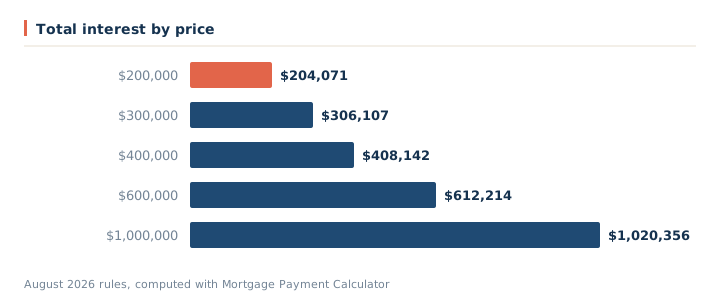
We ran 5 values of price through the calculator and left every other input at its default. As of August 2026, the output was:
| Price ($) | Total interest ($) | Total monthly payment ($) | Principal and interest ($) |
|---|---|---|---|
| 200,000 | 204,071.18 | 1,561.31 | 1,011.31 |
| 300,000 | 306,106.77 | 2,066.96 | 1,516.96 |
| 400,000 | 408,142.36 | 2,572.62 | 2,022.62 |
| 600,000 | 612,213.54 | 3,583.93 | 3,033.93 |
| 1,000,000 | 1,020,355.91 | 5,606.54 | 5,056.54 |
Running price from $200,000 up to $1,000,000 moves total interest from $204,071 to $1,020,356 — a spread of $816,285. That gap is the part a single headline rate never shows.
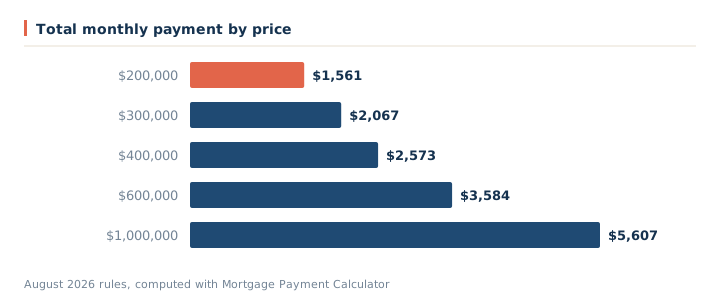
The same runs seen through total monthly payment
At $200,000, total monthly payment works out to $1,561; at $1,000,000 it is $5,607. Looking only at total interest tends to understate how much the outcome shifts across that range.
Assumptions behind these figures
| Input | Value |
|---|---|
| Price | $400,000 |
| Down payment percent | 20% |
| Rate | 6.5% |
| Term | 30 years |
| Property tax annual | $4,800 |
| Insurance annual | $1,800 |
| As of | August 2026 |
| Method | identical to /tools/mortgage-payment-calculator |
Brackets, thresholds and rates change from year to year, so treat these as August 2026 figures for the 2026 tax year. For your own situation, open the Mortgage Payment Calculator and enter your real numbers — the calculator runs the same code that produced every figure on this page.