After years of payments and some appreciation, many owners are sitting on real equity, and two tools let them borrow against it. They get mentioned in the same breath and they behave nothing alike. Before anything else, the part that applies to both: these are secured by your home. If you cannot repay, the lender can ultimately foreclose. This is not credit-card debt with your house as a footnote. The house is the collateral. Borrow accordingly. Everything that follows, the lump sum, the faucet, the borrowable formula, the matching of tool to need, sits underneath that one fact, and any decision that loses sight of it has skipped the only part that is not negotiable.
First, how much you can actually borrow
Both are capped by your equity and a lender's combined loan-to-value limit, frequently around 85% across all mortgages together.
Borrowable ≈ (home value × ~85%) − existing mortgage balance
Estimate it with the Home Equity Calculator before assuming, because the usable figure is normally well below your total equity; the lender keeps a cushion on purpose.
Run one set of numbers so the gap between "equity" and "borrowable" is concrete. Home worth $450,000, existing mortgage balance $250,000. Your equity is $200,000, and that is the number people fixate on. But at an 85% combined loan-to-value limit the lender will allow total mortgage debt of about $382,500, and you already owe $250,000, so the line you can actually open is roughly $132,500, not $200,000. The other $67,500 of equity exists on paper but is the cushion the lender deliberately keeps between you and a falling market. Borrowers who plan around their equity rather than their borrowable amount routinely overshoot by tens of thousands and have to redesign the project, the consolidation, or the plan at the worst possible moment. Start from the borrowable figure, never the equity figure.
The lump sum
A home equity loan is a second mortgage delivered as a one-time lump sum. You receive the full amount up front, the rate is typically fixed, and you repay it in equal installments over a set term. The payment is predictable from day one. It behaves like a disciplined, structured loan: known amount, known rate, known payoff date.
The faucet
A HELOC is a revolving line, closer to a credit card secured by your home. You are approved for a limit and draw only what you need, when you need it, usually at a variable rate. It has two lives. During the draw period, often about ten years, you borrow and repay flexibly and payments may be interest-only. Then the repayment period begins, draws close, and you repay principal plus interest, at which point the payment can jump sharply. The flexibility is genuine and so are the two risks people underestimate: the variable rate and the end-of-draw payment shock.
| Feature | Equity loan | HELOC |
|---|---|---|
| Disbursement | One lump sum | Draw as needed |
| Rate | Usually fixed | Usually variable |
| Payment | Level, predictable | Variable, can spike after draw |
| Best for | A known one-time cost | Ongoing or uncertain costs |
Watch the HELOC payment shock happen
The single most underestimated risk deserves real numbers. Suppose you draw $80,000 on a HELOC during the draw period and, like many borrowers, pay interest only. At a variable rate around 8% that is roughly $533 a month, comfortable, almost invisible in a budget. Then the draw period ends. Now you must repay $80,000 of principal plus interest over, say, fifteen years. That payment jumps to something on the order of $765 a month, and that is if the rate holds. If the variable rate has climbed to 10% by then, the repayment-period payment pushes past $850. The number you budgeted around, $533, was never the real payment; it was the introductory comfort the structure offers before the bill arrives. Borrowers do not get into trouble with HELOCs because the math is hidden. They get into trouble because the draw-period payment is so low it never feels like the debt it is, and then the repayment period turns it into one overnight. Plan every HELOC against the repayment-period payment at a stressed rate, not the draw-period one, and the product becomes safe instead of seductive.
A debt-consolidation example, run honestly
The most common pitch for these tools is consolidating high-rate debt, and the math can be excellent or quietly terrible depending on one behavior. Say you move $40,000 of credit-card debt at 22% onto a home equity loan at 8%. The interest rate alone roughly cuts your interest cost by more than half, and the payment becomes structured and finite instead of revolving forever. That is a genuine, large win, with one condition attached: you do not run the cards back up. If you do, you have not consolidated debt, you have collateralized it against your house and then doubled it, converting an unsecured balance the lender could not take your home over into a secured one they can. The arithmetic of consolidation is almost always favorable. The behavior is what determines whether it was brilliant or catastrophic, and the loan cannot supply the behavior.
Matching the tool to the need
Choose the equity loan for a single, known cost, a defined renovation bid, a fixed debt-consolidation amount, a one-time major expense, especially if an open line of credit would tempt you to overspend. Choose the HELOC for ongoing or uncertain needs, a multi-phase renovation or tuition over several years, when you want to borrow and repay repeatedly and pay interest only on what you actually use, and only if you can absorb a variable rate and have a concrete plan for the repayment-period payment.
There is a third option people forget: cash-out refinance
Home equity loan and HELOC are not the only ways to tap equity; a cash-out refinance replaces your entire first mortgage with a larger one and hands you the difference. Which of the three fits depends mostly on what your existing first mortgage looks like. If you locked a low first-mortgage rate, a cash-out refinance is usually the wrong tool because it re-prices your whole balance at today's rate to access a slice of equity, an expensive way to borrow a little. In that situation a second mortgage, the equity loan or HELOC, leaves the cheap first loan untouched and prices only the new money. If your existing rate is high anyway, a cash-out refinance can sometimes lower the whole loan and provide cash in one move. The decision rule is short: protect a good first-mortgage rate with a second mortgage; only consider cash-out when your first mortgage is not worth protecting. Model the new total payment of whichever path in the Mortgage Payment Calculator before committing, because all three put the house on the line.
The fixed-rate HELOC wrinkle worth asking about
The clean "fixed loan versus variable line" split has a middle option many lenders quietly offer: a HELOC that lets you convert some or all of a drawn balance to a fixed rate. It can blunt the product's biggest risk, locking part of the balance against rising rates while keeping the line's flexibility for the rest. It is not free or universal; terms, fees, and limits vary, and a conversion locks a rate that may be higher than the variable one at that moment. But for a borrower who wants the HELOC's draw-as-needed flexibility yet cannot stomach an entirely variable payment, it is the feature to ask for by name. The point is not that it is always right; it is that the binary the product is usually explained with, fixed lump sum or fully variable line, often has a third setting the borrower is never told about.
The risks, said without softening
Your home is the collateral on both, so neither belongs anywhere near routine consumption you could not otherwise afford. The HELOC payment shock is real: when the draw period ends, interest-only flexibility disappears and the payment can rise substantially, so plan for the repayment-period number, not the draw-period one. Rising rates raise a HELOC payment, so stress-test it higher before relying on it. Borrowing against the home shrinks your safety margin if values fall, which matters if you might need to sell. And both can carry origination, appraisal, and, for HELOCs, annual fees. ## What a $50,000 renovation actually costs
Borrowers price a project at its quote and forget the project is now a loan. Take a $50,000 kitchen funded by a home equity loan at 8% over fifteen years. The payment is roughly $478 a month, and over the full term you repay on the order of $86,000 for a $50,000 kitchen, the extra $36,000 being interest, the real price of borrowing rather than paying cash. That is not an argument against doing it; a renovation that genuinely raises the home's value or makes a long-term home livable can be entirely worth financing. It is an argument for comparing the true financed cost against the value created, not the quote against your enthusiasm. A project that adds $60,000 of durable value and utility for an $86,000 all-in cost is defensible. The same $86,000 spent on something that neither lasts nor returns value is how equity quietly becomes a long, expensive payment for something already forgotten. Always price the project as the loan it actually is.
The fees and the fine print that change the math
Both products carry costs beyond the interest rate, and ignoring them distorts every comparison. Expect possible origination and appraisal fees on either, and HELOCs in particular can carry annual fees, inactivity fees, and early-closure fees that quietly raise the real cost of "flexibility" you may barely use. There is also a tax point worth knowing rather than assuming: interest on money borrowed against your home is treated differently depending on how the funds are used, and the rules have tightened and changed over time, so never bake an assumed deduction into the decision without confirming current rules for your situation. The honest way to compare an equity loan, a HELOC, and a cash-out refinance is on total cost including fees and the real after-everything payment, not on the advertised rate, because the rate is the part the lender wants you to compare and the fees are the part they would rather you did not.
One question that gates all of it
Before the lump-sum-versus-faucet question even matters, answer this one: if your income dropped for six months, could you still make this payment on top of your first mortgage? Not "would it be tight", but "could you make it". Because that is the test the product itself does not apply and the lender's approval does not guarantee. A home equity loan and a HELOC are both, stripped of their packaging, a way of moving your house into the line of fire to fund something. That is entirely rational when the something builds durable value or destroys a worse debt, and you could carry the payment through a bad stretch. It is quietly reckless when the something is consumption, or when the payment only works if nothing in your life goes wrong. The product is neutral. The question is not, and it is the one to settle first.
The common thread across every sensible use is the same: borrowing against your home is justified when it creates value or eliminates worse debt, and almost never when it funds consumption. The lump sum and the faucet are simply two delivery mechanisms for the same underlying act, converting the ownership you have built into debt secured by the roof over your head. Chosen for the right purpose, with the repayment-period payment stress-tested and a real plan to carry it through a bad year, either one is a legitimate, sometimes excellent financial tool. Chosen for convenience or consumption, either one is a slow way to lose the very asset you spent years building. The product will never make that distinction for you, the lender is not paid to make it, and the approval certainly does not make it; the only person standing between a sound use of equity and a regrettable one is the borrower who insisted on answering the gating question honestly before signing. Estimate what you can responsibly borrow with the Home Equity Calculator and model the new payment against your budget in the Mortgage Payment Calculator before you put the house on the line.
Run the numbers
Everything below came out of this site's own Mortgage Payment Calculator. The figures are not quoted from anywhere else: each row is one run of the same calculation the tool page performs, using August 2026 rules. Put the same inputs in and you will get the same output.
How the result moves with price
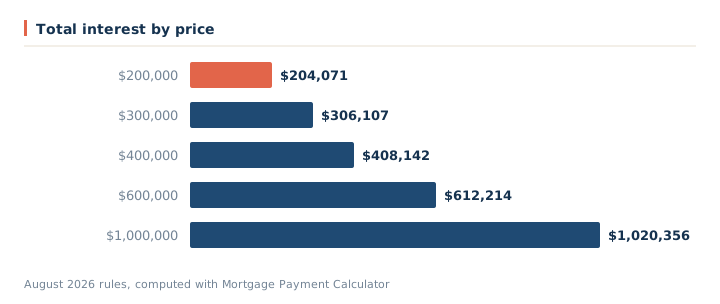
We ran 5 values of price through the calculator and left every other input at its default. As of August 2026, the output was:
| Price ($) | Total interest ($) | Total monthly payment ($) | Principal and interest ($) |
|---|---|---|---|
| 200,000 | 204,071.18 | 1,561.31 | 1,011.31 |
| 300,000 | 306,106.77 | 2,066.96 | 1,516.96 |
| 400,000 | 408,142.36 | 2,572.62 | 2,022.62 |
| 600,000 | 612,213.54 | 3,583.93 | 3,033.93 |
| 1,000,000 | 1,020,355.91 | 5,606.54 | 5,056.54 |
Running price from $200,000 up to $1,000,000 moves total interest from $204,071 to $1,020,356 — a spread of $816,285. That gap is the part a single headline rate never shows.
The same runs seen through total monthly payment
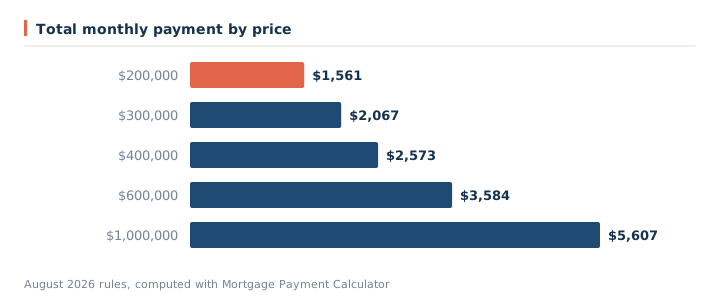
At $200,000, total monthly payment works out to $1,561; at $1,000,000 it is $5,607. Looking only at total interest tends to understate how much the outcome shifts across that range.
Assumptions behind these figures
| Input | Value |
|---|---|
| Price | $400,000 |
| Down payment percent | 20% |
| Rate | 6.5% |
| Term | 30 years |
| Property tax annual | $4,800 |
| Insurance annual | $1,800 |
| As of | August 2026 |
| Method | identical to /tools/mortgage-payment-calculator |
Brackets, thresholds and rates change from year to year, so treat these as August 2026 figures for the 2026 tax year. For your own situation, open the Mortgage Payment Calculator and enter your real numbers — the calculator runs the same code that produced every figure on this page.