Borrow $320,000 for a house at a fairly ordinary rate and, over thirty years, you can hand the lender back more than $720,000. The house did not cost that. The money did.
That gap is the most expensive thing in most people's financial lives, and almost nobody is taught how it is built. It is not built by anything complicated. It comes from one rule applied 360 times in a row. Once that rule is visible, the whole loan stops being a black box, and a handful of decisions that move that $400,000 of interest by tens of thousands become obvious.
One rule does all the work
Interest is the price of using someone else's money. Lenders quote it as an annual percentage, but they do not charge it annually. They charge it every month, and they charge it on the amount you still owe that month.
That second half is the entire story: interest each month = remaining balance × monthly rate. Your balance is largest at the very beginning and shrinks a little every payment, so the dollars of interest are largest at the beginning and shrink every payment too. Nothing about the loan is mysterious after you accept that one sentence.
A quick but important detour, because people mix these up and overpay for it:
| What it covers | When to use it | |
|---|---|---|
| Interest rate | The cost of the borrowed principal only | Estimating the monthly payment |
| APR | The rate plus most lender fees and points, annualized | Comparing two real loan offers |
A loan advertised at a seductively low rate can carry a higher APR than a slightly higher-rate loan with no fees. When you are choosing between lenders, the rate is the headline and the APR is the truth. Compare the APR.
To make that concrete, picture two offers on the same $320,000 loan. Lender A quotes 6.25% but charges two discount points and a fat origination fee. Lender B quotes 6.5% with almost no fees. The monthly payment on Lender A looks better in isolation, but once the points and fees are rolled in and annualized, Lender A's APR can land above Lender B's. Unless you will hold the loan long enough to earn back those upfront costs through the lower rate, the "cheaper" loan is the expensive one. The rate sells the loan; the APR prices it.
Points: buying a lower rate, and when it pays
Discount points are prepaid interest. One point costs 1% of the loan and typically lowers the rate by a fraction of a percent. On the $320,000 example, paying one point ($3,200) to shave the rate might cut the payment by roughly $50. Divide the cost by the monthly saving and you get a break-even, here around five to six years. Stay past it and the points were a good trade; sell or refinance before it and you simply donated the money. Points are not good or bad in the abstract. They are a bet on how long you will keep this exact loan, and most people overestimate that number.
The payment is engineered backwards
Your fixed monthly payment is not a round number someone picked. It is solved for. The lender starts from the answer they want (a balance of exactly zero on the final payment) and works backward to the payment that produces it:
M = P × r(1 + r)ⁿ ÷ [ (1 + r)ⁿ − 1 ]
P is what you borrow, r is the annual rate divided by twelve, and n is the number of monthly payments. You will never need to evaluate this by hand, and the Mortgage Payment Calculator does it instantly while you change the inputs. It is shown here only because seeing where the payment comes from explains the strange thing that happens next.
Watch five years go by
Take a real case: $320,000 borrowed at 6.5% for 30 years. The solved payment is about $2,022 a month, and it never changes. What changes, dramatically, is what that $2,022 is buying.
| Payment | Goes to interest | Goes to principal | Balance left |
|---|---|---|---|
| 1st | ~$1,733 | ~$289 | ~$319,711 |
| 12th | ~$1,706 | ~$316 | ~$316,500 |
| 60th (year 5) | ~$1,587 | ~$435 | ~$292,500 |
| 180th (year 15) | ~$1,144 | ~$878 | ~$210,200 |
| 360th (final) | ~$11 | ~$2,011 | $0 |
Read the first row again. You sent $2,022 and the loan balance dropped by $289. The other $1,733 simply paid rent on the money. After a full year of payments, this borrower has paid down less than $3,500 of a $320,000 loan. That is not a penalty or a trick. It is the one rule doing exactly what it does: the balance is huge, so the interest slice is huge.
The split slowly inverts. Somewhere around year eighteen on this loan, for the first time, more of the payment attacks principal than feeds interest. By the end the relationship has completely flipped and almost the entire payment is principal. Over the whole run this borrower pays roughly $408,000 in interest on a $320,000 loan.
This single picture is why everything in the next section matters. Anything that shrinks the balance sooner, lowers the rate, or shortens the clock attacks the biggest cost in the whole arrangement.
The five things that actually change the number
There are only five. They are not equally powerful, and they stack.
A lower rate. This is the heavyweight. Drop the example from 6.5% to 5.5% and the payment falls roughly $200, but the headline is the lifetime figure: about $73,000 less interest for the same house. This is the entire reason a quarter of a percentage point is worth a hard afternoon of shopping lenders.
A bigger down payment. Every dollar you put down is a dollar that never appears in the balance, so it never generates a single cent of interest across thirty years. A larger down payment also lowers your loan-to-value ratio, which can earn a better rate and remove mortgage insurance. It works on three fronts at once.
A shorter term. A 15-year loan hurts monthly and helps enormously overall, because you are renting the money for half as long and usually at a lower rate on top of that. Put both terms side by side in the Mortgage Payment Calculator and compare the lifetime interest, not the monthly payment. The difference is routinely six figures on an ordinary loan.
Extra principal, early. Any dollar you pay above the scheduled amount goes straight to the balance and erases every future dollar of interest that balance would have produced. Timing is everything: a dollar of extra principal in year two removes far more interest than the same dollar in year twenty, because it had decades left to accrue. On the $320,000 example, an extra $200 a month retires the loan roughly six years early and saves on the order of $95,000. Confirm there is no prepayment penalty, then point any windfall at the principal in the early years.
A refinance when rates fall. If market rates drop well below yours after you close, replacing the loan with a cheaper one resets the math. It is not free; closing costs mean it only pays once you hold the new loan past a break-even point. Model your specific numbers in the Mortgage Refinance Calculator before assuming a lower rate wins.
The same house, four ways, in lifetime interest
The five levers are abstract until you see them collide on one loan. Same $320,000, same house:
| Choice | Monthly P&I | Lifetime interest |
|---|---|---|
| 30 years @ 6.5% | ~$2,022 | ~$408,000 |
| 30 years @ 5.5% | ~$1,817 | ~$334,000 |
| 30 years @ 6.5% + $200/mo to principal | ~$2,222 | ~$313,000 |
| 15 years @ 6.0% | ~$2,700 | ~$166,000 |
Look at the bottom row against the top one. It is the identical house and the identical price; the only thing that changed is how long you rent the money and at what rate, and the cost of the loan fell by roughly $242,000. None of this required a windfall or a financial trick. It required understanding that interest is balance times rate times time, and then deliberately attacking each of those three terms. The person who signs the top row without looking and the person who engineers the bottom row are not in different financial situations. They made the same purchase with different information.
Why the first decade is the only one that really matters
Because interest is charged on the balance and the balance is largest at the start, the early years are where every dollar has maximum leverage, and almost nobody acts on this while it is still true. Watch what one extra $300 a month does depending on when you start it on the $320,000 loan:
| When you add $300/mo to principal | Roughly years cut | Roughly interest saved |
|---|---|---|
| From month 1 | ~7 years | ~$120,000 |
| Starting in year 10 | ~4 years | ~$58,000 |
| Starting in year 20 | ~1.5 years | ~$16,000 |
The exact same $300, the same discipline, the same loan, worth eight times more applied early than late. This is the single most actionable consequence of the one rule, and it runs against instinct: people tend to have the least spare money in the early years and the most later, which is precisely backwards from when the payment matters. Even small extra principal in the first decade, a tax refund, a bonus, a raise not absorbed into lifestyle, outperforms much larger sums thrown at the loan near the end. Model your own version in the Mortgage Payment Calculator before you decide an extra payment is too small to bother with; the table usually changes that opinion.
A note on how the interest is timed
Most fixed-rate U.S. mortgages accrue interest monthly on the period's starting balance. They do not compound against themselves within the loan the way credit-card debt does, which is why the amortization table above is so predictable. Some products, and most lines of credit such as a HELOC, accrue interest daily, where each day costs balance × (rate ÷ 365). On those, the calendar date of a payment genuinely changes the interest. On a standard monthly mortgage, paying three days early does not change that month's interest, but extra principal always does.
Four beliefs worth unlearning
Some of the most confident mortgage advice is wrong in a way that costs money.
"My rate is fixed, so my interest is fixed." The payment is fixed. The interest portion of it falls every single month while the principal portion climbs. Those are different statements.
"A lower monthly payment is cheaper." Frequently the opposite. Stretching a balance over a longer term lowers the monthly figure precisely by keeping you in debt, and in interest, for more years.
"Biweekly payments are a magic trick." There is no magic. Paying half every two weeks produces 26 half-payments, which is 13 full payments, which is one extra payment a year. The savings come entirely from that extra principal. You can replicate it for free by adding one-twelfth of a payment to principal each month and skipping any service that charges a fee to "set up" biweekly.
"Negative amortization is just slow progress." It is the opposite of progress. If a payment fails to cover even the month's interest, the shortfall is added to the balance and you owe more over time. Standard fixed-rate mortgages never do this; some exotic products can, which is reason enough to read the structure before signing.
What this means the next time you are deciding
Strip away the jargon and a mortgage is balance times rate, recalculated monthly, for as long as you owe the money. That one idea tells you why the early years feel like running in sand, why a slightly lower rate is worth fighting for, and why an extra payment in year two is one of the highest-return moves available to a household.
Before you commit to any loan, do two concrete things. Put your real numbers through the Mortgage Payment Calculator and look at the lifetime interest, not just the comfortable monthly figure. Then change one variable at a time and watch which lever moves it most for your situation. The arithmetic is on your side once you can see it, and it stays on your side for the entire length of the loan: the same one rule that explains why year one barely moves the balance also explains why a refinance has a break-even, why a longer term quietly costs more, and why an extra payment in year two outperforms a much larger one in year twenty. Learn the rule once and you do not just understand this loan; you can interrogate every mortgage decision you will ever be offered, which is the only durable defense against being sold the friendlier of two numbers.
Run the numbers
Everything below came out of this site's own Mortgage Payment Calculator. The figures are not quoted from anywhere else: each row is one run of the same calculation the tool page performs, using August 2026 rules. Put the same inputs in and you will get the same output.
How the result moves with price
We ran 5 values of price through the calculator and left every other input at its default. As of August 2026, the output was:
| Price ($) | Total interest ($) | Total monthly payment ($) | Principal and interest ($) |
|---|---|---|---|
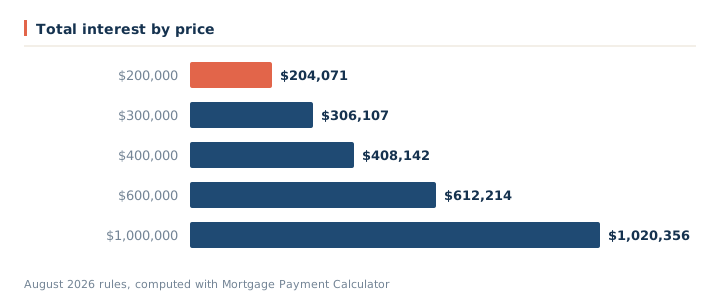
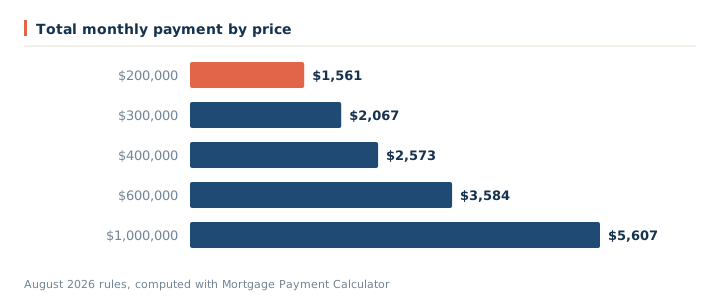
| 200,000 | 204,071.18 | 1,561.31 | 1,011.31 |
| 300,000 | 306,106.77 | 2,066.96 | 1,516.96 |
| 400,000 | 408,142.36 | 2,572.62 | 2,022.62 |
| 600,000 | 612,213.54 | 3,583.93 | 3,033.93 |
| 1,000,000 | 1,020,355.91 | 5,606.54 | 5,056.54 |
Running price from $200,000 up to $1,000,000 moves total interest from $204,071 to $1,020,356 — a spread of $816,285. That gap is the part a single headline rate never shows.
The same runs seen through total monthly payment
At $200,000, total monthly payment works out to $1,561; at $1,000,000 it is $5,607. Looking only at total interest tends to understate how much the outcome shifts across that range.
Assumptions behind these figures
| Input | Value |
|---|---|
| Price | $400,000 |
| Down payment percent | 20% |
| Rate | 6.5% |
| Term | 30 years |
| Property tax annual | $4,800 |
| Insurance annual | $1,800 |
| As of | August 2026 |
| Method | identical to /tools/mortgage-payment-calculator |
Brackets, thresholds and rates change from year to year, so treat these as August 2026 figures for the 2026 tax year. For your own situation, open the Mortgage Payment Calculator and enter your real numbers — the calculator runs the same code that produced every figure on this page.