Most fixed-versus-ARM advice collapses into a bumper sticker: fixed is safe, adjustable is risky. That framing has talked careful people out of thousands in savings and talked others into payment shocks they never modeled. The honest version is less dramatic. Each loan is correct for a different time horizon, and the horizon is the question, not the rate.
What a fixed rate is really selling
With a fixed-rate mortgage the rate is locked for the entire term. The principal-and-interest portion in year one is identical to year twenty-eight. Inflation, central-bank moves, and market panics cannot touch it.
You are buying certainty, and certainty has a sticker price: a fixed rate almost always starts above the introductory rate on a comparable ARM. That is the entire trade in one line. You accept a higher cost at the start in return for zero interest-rate risk for as long as you owe the money.
What an ARM actually does, under the hood
An ARM has two lives. First a fixed introductory period at a low rate, then periodic adjustments tied to the market. The name encodes it: a 7/6 ARM is fixed for seven years, then adjusts every six months.
After the fixed period the new rate is built from two parts. The index is a published market rate that moves with the economy. The margin is a fixed number the lender adds on top, set in your contract, and it never changes. Your new rate is index plus margin, bounded by caps. Two ARMs with identical teaser rates can behave completely differently after reset if their margins differ, which is why the margin is the number to ask for and the one borrowers most often never see.
Caps bound the damage and are usually written as three figures, for example 2/1/5:
| Cap | Limits | On a 5% start |
|---|---|---|
| Initial | The first adjustment | up to 7% |
| Periodic | Each later adjustment | +1% per period |
| Lifetime | The ever-maximum | ceiling of 10% |
Caps are protection, but read what they protect. The "protected" worst case here is still a payment built on a 10% rate. Before accepting any ARM, compute the payment at the lifetime cap and ask whether your budget survives it. Plan on the maximum, not the teaser.
The numbers, side by side
A $350,000 loan, 30-year fixed at 6.75% versus a 7/6 ARM starting at 5.75%:
| Scenario | Monthly P&I |
|---|---|
| Fixed 6.75% | ~$2,270 |
| ARM intro 5.75% (years 1–7) | ~$2,042 |
| ARM at lifetime cap (10.75%) | ~$3,150+ |
The ARM saves roughly $228 a month for seven years, about $19,000, then exposes you to a payment that could climb above $3,150. Whether that is a brilliant trade or a trap depends entirely on whether you are still holding the loan when the risk arrives. Model your own figures with the ARM vs Fixed Calculator before deciding which story is yours.
Walk through one reset, step by step
Abstract caps mean nothing until you watch them act on a real balance, so follow the same $350,000 7/6 ARM into year eight. The 5.75% start is built, suppose, from a 3.25% margin over a 2.50% index. Seven years in you have paid the balance down to roughly $312,000, and the index has drifted to 4.50%. The contract rate wants to become 4.50% plus the 3.25% margin, which is 7.75%. The 2% initial cap will not let it jump that far in one move from 5.75%, so the first reset lands at 7.75% only if that is within the cap; here the cap allows up to 7.75% on the first adjustment, so it applies in full. Payment on $312,000 over the remaining 23 years at 7.75% is about $2,365, up from $2,042. That is a $323 monthly increase arriving in a single month, and the index only moved two points. Nothing went wrong in this scenario. This is the loan working exactly as written.
Now run the unfriendly version. The index climbs to 6.50% by year eight. The math wants 6.50% plus 3.25%, which is 9.75%, and each subsequent six-month period can add another point until the 10% lifetime ceiling. Within a year the rate can sit near its cap, and the payment on the remaining balance pushes past $3,100. The teaser bought you seven good years and then handed you a number you must be able to pay. The honest way to shop an ARM is to compute that ceiling payment first and treat the teaser as the discount you receive for accepting it.
The break-even horizon, made concrete
| You sell or refinance in… | ARM result vs fixed | Verdict |
|---|---|---|
| Year 3 | Full intro savings, no reset risk taken | ARM clearly wins |
| Year 7 (just before reset) | ~$19,000 saved, exited clean | ARM wins |
| Year 9 (two years past reset) | Intro savings partly eroded by higher payments | Roughly a wash |
| Year 15 (held through caps) | Years of above-fixed payments | Fixed usually wins |
The pattern is not subtle. The ARM's advantage is entirely front-loaded and the fixed loan's advantage is entirely back-loaded, so the crossover sits a year or two past the reset. If your evidence-based holding period ends before that crossover, the ARM is the cheaper instrument. If it ends after, you are paying for a discount you will not be around long enough to keep.
"I'll just refinance before it resets" deserves a hard look
This is the single most common rationalization, and it quietly assumes three things will all be true on a date years away: rates will be low enough to make refinancing worthwhile, your credit will still qualify you, and your home will still appraise high enough to support the new loan. None of those is guaranteed, and they tend to fail together. The same economic stress that pushes the index up, hurting your reset, is often the environment where rates are high and home values soft, so the escape hatch is jammed shut precisely when you reach for it. Refinancing as an exit is a reasonable hope. It is not a plan, and an ARM chosen because of it is an ARM whose worst case you have not actually accepted.
When the ARM is the smart money
The ARM rewards a short, confident horizon. It fits when you expect to sell before the fixed period ends for a concrete reason such as a known relocation, when you will aggressively pay down principal so the eventual higher rate applies to a much smaller balance, or when you have a credible expectation of refinancing before reset and can absorb the risk that rates or your credit may not cooperate. The operative word is confident. "I'll probably move at some point" is a feeling. A lease-up timeline or a posting with an end date is a plan.
Two borrowers, the same loan, opposite outcomes
Picture two people who sign the identical 7/6 ARM on the same street in the same week. The first is a physician finishing a contract with a known relocation in year five; she banks the roughly $228 monthly difference, sells in year four when the contract ends, and the reset she never reaches is a clause she was never going to trigger. She did not beat the market. She matched the loan to a date she could prove. The second buyer took the same loan because the lower payment let him qualify for a house at the edge of his budget and "figured rates would come down." Year eight arrives, rates have not cooperated, and the reset turns a tight payment into an impossible one. Same contract, same caps, same margin. The only variable that differed was whether the holding period was a documented plan or a hopeful feeling, and that single variable decided everything. This is why the rate comparison is the least interesting part of the decision.
When the fixed rate is the smart money
Choose fixed when you will stay well past any ARM's fixed window, when you need a payment that cannot move in order to budget or sleep, or when your income could not absorb the worst case the caps allow. For most owner-occupiers buying a long-term home in a normal-to-low rate environment, locking a decent rate forever is itself the win, and the ARM's savings are real but front-loaded and conditional on guessing the future correctly.
Read your own ARM disclosure before anyone explains it to you
You do not have to take a loan officer's summary on faith, because the contract states every number that decides your future payment. Find five things and you have the whole loan. The fixed period, how many years until the first adjustment. The adjustment frequency after that, annually or every six months. The index it follows, a specific named market rate you can look up yourself. The margin, the fixed number added to that index, which never changes and is where lenders quietly differ. And the caps, the initial, periodic, and lifetime limits. With those five, compute two payments on your own: the teaser payment you will actually start with, and the payment at the lifetime cap on your expected balance at reset. If the loan officer's description and your two numbers disagree, trust your arithmetic and ask why. The single most common way borrowers are surprised by an ARM is not deception; it is never having read the five numbers that were disclosed to them in writing the entire time.
Not all ARMs are the same animal
The two-digit name tells you the rhythm, and the rhythm changes how much risk you are taking. A 5/1 ARM is fixed five years then adjusts annually; a 7/6 is fixed seven years then every six months; a 10/6 is fixed a full decade. The longer the first number, the more the loan resembles a fixed mortgage and the smaller the bet, but the smaller the teaser discount too, because the lender is giving you more certainty. A 5/1 with a deep discount is a sharp instrument for someone with a three-year plan and a thin appetite for it past then. A 10/6 is closer to a fixed loan with an asterisk, sensible for a buyer who is fairly but not perfectly sure they will be gone within a decade. Match the fixed window to your horizon with margin to spare, because the period you can defend with evidence is shorter than the period you imagine.
Stress-test your own budget before you sign
Do this with your real numbers, not the brochure's. Take the lifetime cap rate, apply it to your loan amount and remaining term, and look at the resulting payment next to your actual take-home pay. If that number forces you to cut essentials, you cannot afford the ARM, full stop, no matter how comfortable the teaser feels. If that number is uncomfortable but survivable, the ARM is a calculated risk you are entitled to take. If that number barely registers because your income is high or you will obliterate the principal early, the ARM is close to free money. The teaser payment tells you nothing about whether you can carry this loan. The cap payment tells you everything, and it is the only payment you should make the decision on.
The four ways people get hurt
The mistakes are predictable. Budgeting on the introductory rate, which is temporary by design, rather than the post-reset worst case. Assuming you can always refinance out, when refinancing depends on future rates, future credit, and future home value, none guaranteed. Ignoring the margin, so a mild index still produces a painful reset. And treating "I might move" as a plan, when the reset does not care about your intentions.
If you take one idea from this: a fixed rate is a position, an ARM is a bet with a deadline. Bets are fine when you know the deadline and can pay if you lose. The borrowers who do well with ARMs are not the ones who guessed rates correctly; they are the ones who chose a loan whose worst case they had already priced and could afford, and whose exit was a documented date rather than a hope. The borrowers who get hurt almost always made the opposite trade without noticing. Match the loan to the length of time you can say, with evidence, that you will keep it, stress-test every ARM at its lifetime cap before you sign anything, and remember that the comfortable teaser payment is the bait, not the deal.
Run the numbers
Everything below came out of this site's own Mortgage Payment Calculator. The figures are not quoted from anywhere else: each row is one run of the same calculation the tool page performs, using August 2026 rules. Put the same inputs in and you will get the same output.
How the result moves with price
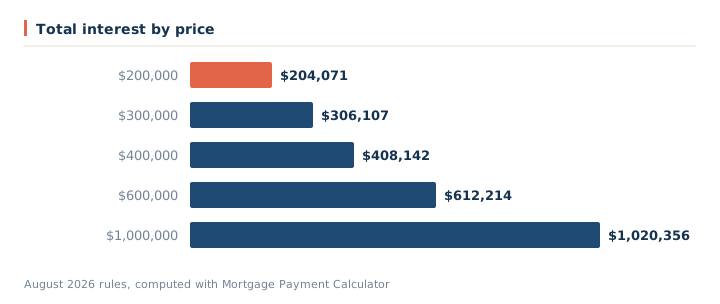
We ran 5 values of price through the calculator and left every other input at its default. As of August 2026, the output was:
| Price ($) | Total interest ($) | Total monthly payment ($) | Principal and interest ($) |
|---|---|---|---|
| 200,000 | 204,071.18 | 1,561.31 | 1,011.31 |
| 300,000 | 306,106.77 | 2,066.96 | 1,516.96 |
| 400,000 | 408,142.36 | 2,572.62 | 2,022.62 |
| 600,000 | 612,213.54 | 3,583.93 | 3,033.93 |
| 1,000,000 | 1,020,355.91 | 5,606.54 | 5,056.54 |
Running price from $200,000 up to $1,000,000 moves total interest from $204,071 to $1,020,356 — a spread of $816,285. That gap is the part a single headline rate never shows.
The same runs seen through total monthly payment
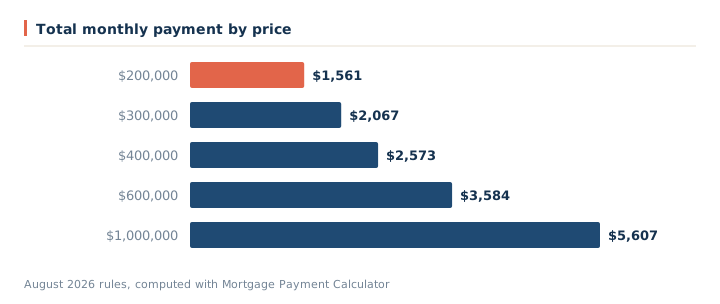
At $200,000, total monthly payment works out to $1,561; at $1,000,000 it is $5,607. Looking only at total interest tends to understate how much the outcome shifts across that range.
Assumptions behind these figures
| Input | Value |
|---|---|
| Price | $400,000 |
| Down payment percent | 20% |
| Rate | 6.5% |
| Term | 30 years |
| Property tax annual | $4,800 |
| Insurance annual | $1,800 |
| As of | August 2026 |
| Method | identical to /tools/mortgage-payment-calculator |
Brackets, thresholds and rates change from year to year, so treat these as August 2026 figures for the 2026 tax year. For your own situation, open the Mortgage Payment Calculator and enter your real numbers — the calculator runs the same code that produced every figure on this page.