The fear is rational. Buying a first home means making twenty unfamiliar decisions at once, any one of which could be an expensive mistake, and you have no practice at any of them. The fix is not nerve. It is information, applied in the right order.
A definition worth knowing before anything else: most assistance programs treat you as a first-time buyer if you have not owned a primary residence in the past three years, even if you owned one before that. Plenty of people qualify for first-time help without realizing it. Check before you assume you are out.
You need four piles of cash, not one
The down payment gets all the attention and causes the classic first-timer cash crunch, because it is one of four needs and the only one anyone talks about.
| Cash need | Typical size | Notes |
|---|---|---|
| Down payment | 3%–20% of price | Lower options exist (below) |
| Closing costs | 2%–5% of the loan | Lender, title, taxes, prepaids |
| Moving and setup | $1,000–$5,000+ | Movers, deposits, first repairs |
| Reserve fund | 3–6 months of payments | The safety net, not optional |
The Down Payment Calculator turns a target percentage into a monthly plan, and the Closing Cost Calculator sizes the second-largest item, the one people are most likely to forget until it lands.
Add the four piles up on one real purchase so the number is honest. A $300,000 home with 5% down: the down payment is $15,000. Closing costs at the middle of the range are roughly $9,000. Moving, deposits, and the first round of inevitable small repairs, call it $3,000 conservatively. And a reserve of three to six months of the new payment, easily $9,000 to $15,000. The headline number was $15,000; the real cash to buy and not be fragile the next morning is closer to $36,000–$42,000. This is the calculation that ambushes first-timers, not because it is hidden but because every conversation fixates on the down payment and silently treats the other three piles as zero. Knowing the true total early is the difference between buying when you are ready and discovering at the closing table that you are $12,000 short of safe.
The 20% myth, with the math of waiting
The single most expensive piece of folk wisdom in home buying is that you need 20% down. You do not. On a conventional loan, 20% has exactly one real benefit, which is avoiding PMI, plus a lower payment as a consequence. The actual minimums are far lower.
| Loan type | Typical minimum down | Mortgage insurance |
|---|---|---|
| Conventional | 3% | PMI, removable near 20% equity |
| FHA | 3.5% | MIP, often life-of-loan |
| VA (eligible veterans) | 0% | None (one-time funding fee) |
| USDA (eligible rural) | 0% | Guarantee fee |
Now the part the slogan ignores. Suppose you could buy now with 5% down but decide to wait three years to reach 20%. During those three years you pay rent that probably rises, you capture none of the appreciation on a home you do not own yet, and in many markets the price itself climbs, which moves the 20% target away from you faster than you can save toward it. In a lot of real cases, the rent paid and appreciation missed while waiting exceed the PMI you were avoiding. The lesson is not "always buy now." It is that waiting is not free, and pretending it is costs people more than PMI ever did. Model both timelines with the Mortgage Affordability Calculator before you decide which is actually cheaper for you.
One firm rule survives all of this: never drain your emergency fund to reach 20%. House-rich and cash-poor turns the first broken furnace into a crisis.
Programs, decoded
There is an entire ecosystem built specifically to lower the barrier for first-timers, and most people never look at it.
Down payment assistance, often run by state Housing Finance Agencies, can provide grants or low- or zero-interest second loans toward the down payment or closing costs. Terms vary widely; some are forgiven if you stay a certain number of years, others are repaid when you sell. Beyond that, there are conventional programs aimed at low-to-moderate-income buyers with reduced PMI and flexible underwriting, usually gated by income limits relative to the area. A Mortgage Credit Certificate can turn part of your annual mortgage interest into a federal tax credit, quietly lowering your true housing cost. And many programs require a short homebuyer education course, which is not just a hoop; graduates have measurably fewer problems, and the course often unlocks better terms or eligibility.
Program names, funding, and rules change constantly and differ by location, so treat the above as categories to investigate, not a menu to order from. Confirm specifics with your state agency and a lender before counting on any single program.
Two of these are worth a concrete glance because buyers undervalue them. A down payment assistance second loan that covers, say, $10,000 of your down payment can be the entire difference between buying this year and buying in three, and if it is structured as forgivable after a residency period, it can effectively become a grant you never repay, which reshapes the whole "cost of waiting" calculation. A Mortgage Credit Certificate works differently: it converts a portion of the mortgage interest you pay each year into a direct federal tax credit, not a deduction, so on a typical loan it can quietly return a four-figure sum annually, lowering your true cost of ownership for as long as you hold the loan and qualify. Neither is exotic and neither finds you; both sit unused mostly because first-timers assume assistance is not for them and never ask. The thirty minutes spent on your state Housing Finance Agency's site before you shop is some of the highest-paid time in the entire process.
The cost nobody budgets for
Renters pay rent. Owners pay rent's hidden relatives, and underestimating them is the most common first-year shock. Property taxes are escrowed monthly and can jump after a sale-triggered reassessment. Homeowners insurance is required and varies sharply by location. PMI or MIP applies if you put little down. Maintenance is the sleeper: a common planning figure is roughly 1% of the home's value per year, and older homes want more. HOA dues, if they apply, can rise. Utilities are usually higher than an apartment and now entirely yours. Put the full picture through the Mortgage Affordability Calculator so your budget reflects the cost of owning, not just the principal and interest.
What year one actually costs, lined up
The "rent's hidden relatives" become real when totaled on a $300,000 home in the first year of ownership:
| Cost | Rough monthly | Notes |
|---|---|---|
| Principal & interest | ~$1,800 | The only number most buyers plan for |
| Property tax | ~$300 | Escrowed; can rise after a sale reassessment |
| Homeowners insurance | ~$130 | Required; varies sharply by location |
| PMI (if low down) | ~$150 | Cancellable later on a conventional loan |
| Maintenance reserve | ~$250 | ~1% of value/year, arrives lumpy not monthly |
| Realistic total | ~$2,630 | vs the ~$1,800 the budget assumed |
The gap between the $1,800 a first-timer mentally signs up for and the ~$2,630 the house actually costs is the single most common reason year one feels like drowning. None of these lines is a surprise to the system; they are only a surprise to the buyer who budgeted off principal and interest. Run the full picture through the Mortgage Affordability Calculator so the number you commit to is the number you will actually pay.
"Approved for" is a ceiling, not a target
A lender's approval is the most misread number in the process. It tells you the maximum the formula permits, computed from gross income and the debts that happened to show on a credit report, with no knowledge of your childcare, your retirement goals, your commute, or how you actually want to live. Buying at the very top of it means every month is the tight month, and the first job change, medical bill, or failed water heater has nowhere to go. The disciplined move is to deliberately buy below the ceiling, often well below, so the payment leaves room for the rest of a life and the inevitable bad quarter. Two buyers approved for the identical amount can be in completely different financial health a year later purely because one treated the approval as permission and the other treated it as a recommendation. It is the former.
Six mistakes, ranked by what they cost
Shopping for homes before getting pre-approved wastes time on houses you cannot finance and strips your credibility with sellers. Maxing out the approved amount mistakes a ceiling for a recommendation and leaves zero margin for a job change or a repair, so deliberately buy below it. Skipping the inspection to win a bidding war can mean inheriting a five-figure problem; the inspection fee is the cheapest insurance you will ever buy. Taking only one loan quote forfeits real money over thirty years, so compare at least three by APR. Making big financial moves between pre-approval and closing can sink the loan outright, so freeze your finances until you hold the keys. And buying with no thought to resale, even for a "forever" home, ignores that location, layout quirks, and school zones decide how easily you can leave; buy with one eye on the exit.
Notice the pattern. Almost every expensive first-timer mistake is a preparation failure, not a knowledge failure. That is good news, because preparation is entirely within your control.
The inspection is the cheapest insurance you will ever buy
In a competitive market, first-timers are routinely pressured to waive the inspection to make an offer more attractive, and it is the most expensive corner a beginner can cut. Put numbers on it. An inspection costs a few hundred dollars. The problems it surfaces, a failing roof, a cracked heat exchanger, foundation movement, aging electrical, are five-figure repairs, and discovering one before closing means you can renegotiate the price, demand repairs, or walk away. Discovering it after closing means it is entirely yours. Waiving inspection to win a bidding war can mean "winning" a house with $40,000 of deferred problems you agreed not to look for. There are markets and moments where some inspection flexibility is the price of competing, but waiving the right to know what you are buying should be a deliberate, eyes-open risk with a price attached, never a default a nervous buyer accepts because an agent suggested it. The fee is not a cost; it is the cheapest option you will ever be sold.
Buy with the exit in mind, even for a "forever" home
First-timers fall in love and stop thinking, which is human and expensive. Almost everyone sells or refinances eventually, plans change, jobs move, families grow, and the features that are easy to ignore while infatuated, an awkward layout, a busy road, a weak school zone, a price already at the top of the street, are exactly what determines how easily and profitably you can leave. This is not cynicism about a home you love; it is the recognition that the most reliable wealth outcome in housing comes from a property that is also easy for the next buyer to want. Buying with one quiet eye on resale does not mean buying without joy. It means refusing to let the joy talk you out of the questions a calmer version of you would insist on, because the version of you that sells in seven years inherits every one of those decisions.
Your first ninety days
Spend the early weeks strengthening credit and cutting debt while you set a real budget with the Mortgage Affordability Calculator, not the bank's maximum. Research your state and local first-time programs and the required education course early, because they take time. Save the down payment plus closing costs plus a reserve, tracked against a target with the Down Payment Calculator. Then get pre-approved, compare three or more lenders, make offers inside budget with an inspection contingency, freeze your finances, respond to underwriting fast, verify the Closing Disclosure, and close.
Done in that order, the frightening leap becomes a managed process. The buyers who get hurt are almost never the ones who knew the least. They are the ones who skipped the preparation, and preparation, unlike market timing or luck, is the one part of this entirely within your control.
Run the numbers
Everything below came out of this site's own Mortgage Affordability Calculator. The figures are not quoted from anywhere else: each row is one run of the same calculation the tool page performs, using August 2026 rules. Put the same inputs in and you will get the same output.
How the result moves with income
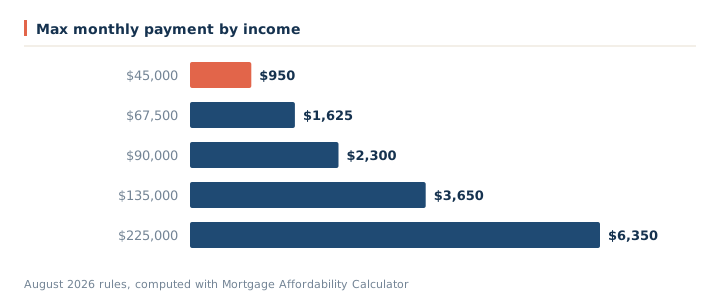
We ran 5 values of income through the calculator and left every other input at its default. As of August 2026, the output was:
| Income ($) | Max monthly payment ($) | Loan amount ($) | Home price affordable ($) |
|---|---|---|---|
| 45,000 | 950 | 150,300.28 | 210,300.28 |
| 67,500 | 1,625 | 257,092.58 | 317,092.58 |
| 90,000 | 2,300 | 363,884.88 | 423,884.88 |
| 135,000 | 3,650 | 577,469.49 | 637,469.49 |
| 225,000 | 6,350 | 1,004,638.7 | 1,064,638.7 |
Running income from $45,000 up to $225,000 moves max monthly payment from $950 to $6,350 — a spread of $5,400. That gap is the part a single headline rate never shows.
The same runs seen through loan amount
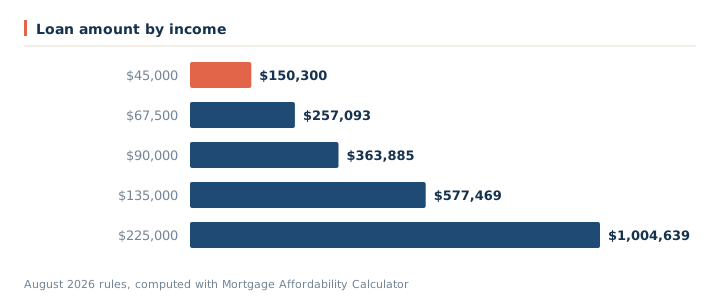
At $45,000, loan amount works out to $150,300; at $225,000 it is $1,004,639. Looking only at max monthly payment tends to understate how much the outcome shifts across that range.
Assumptions behind these figures
| Input | Value |
|---|---|
| Income | $90,000 |
| Monthly debts | $400 |
| Down payment | $60,000 |
| Rate | 6.5% |
| Term | 30 years |
| As of | August 2026 |
| Method | identical to /tools/mortgage-affordability-calculator |
Brackets, thresholds and rates change from year to year, so treat these as August 2026 figures for the 2026 tax year. For your own situation, open the Mortgage Affordability Calculator and enter your real numbers — the calculator runs the same code that produced every figure on this page.