"You need twenty percent down." It is repeated like a law of nature, and it has quietly cost more people money than almost any other piece of financial folklore. Not because saving more is bad, but because waiting years to hit an arbitrary number has a price that nobody puts on the other side of the ledger.
Here is the more useful truth: twenty percent does one specific job, the real minimums are far lower, and the right number for you is arithmetic, not a slogan.
What the down payment is doing for you
Your down payment is the cash slice of the price; the loan covers the rest. It works on three levers at once. It shrinks the loan, and therefore the lifetime interest, dollar for dollar. It sets your loan-to-value ratio, which influences your rate and whether you owe mortgage insurance. And it creates instant equity, your ownership stake from day one. Every extra dollar down is a dollar you never pay interest on for up to thirty years, which is exactly why the decision deserves real thought instead of a reflex.
The real floor is nowhere near 20%
| Loan type | Typical minimum | Mortgage insurance |
|---|---|---|
| Conventional | 3% | PMI, removable near 20% equity |
| FHA | 3.5% | MIP, often life-of-loan |
| VA (eligible veterans) | 0% | None (one-time funding fee) |
| USDA (eligible rural) | 0% | Guarantee fee |
A buyer with solid credit can purchase a $300,000 home with roughly $9,000 down on a 3% conventional loan, not $60,000. The gap between those two numbers is years of someone's life.
What the minimum does not include
There is a fair warning buried in that good news. The minimum is the down payment only; it is not the cash you need to close. On top of the $9,000 you will owe closing costs, commonly another 2% to 5% of the loan, plus the lender's required reserves, often a couple of months of payments sitting in your account untouched. A realistic cash-to-close on that $300,000 purchase is closer to $15,000–$22,000 once everything is counted, even on a 3%-down loan. This is not an argument for the 20% myth; the real total is still a fraction of $60,000. It is an argument for planning the whole number instead of the headline one, because the most painful version of the down-payment mistake is arriving at the closing table short by the costs nobody mentioned.
Where the down payment is allowed to come from
Lenders care not just how much you put down but where it came from, and this trips up buyers who assume any money is fine. Funds generally must be "sourced and seasoned," meaning traceable and sitting in your account long enough to look like yours rather than a sudden deposit. Gift money from family is widely allowed on most loan types, but it needs a gift letter stating it is not a loan, and large unexplained deposits will be questioned. Down payment assistance programs, forgivable grants, deferred second loans, and first-time-buyer bonds, exist in nearly every state and routinely cover part or all of the down payment and sometimes closing costs for buyers under income limits. They are underused mostly because people assume they will not qualify and never check. Before deciding you cannot afford to buy, find out what your state housing agency actually offers; the answer reshapes the math for a large share of would-be buyers.
So what does 20% actually buy?
Three concrete things, all on a conventional loan. It removes PMI, which on a $300,000 loan can run anywhere from about $75 to $300-plus a month depending on credit. Estimate yours with the PMI Calculator. It lowers the monthly payment because you borrowed less. And it can earn a slightly better rate, since lower loan-to-value is lower risk. Twenty percent is not a requirement. It is an optimization, and the only real question is whether reaching it is worth what the wait costs.
The math nobody runs: the cost of waiting
Suppose you could buy now with 5% down but choose to wait three years to reach 20%. Across those three years you pay rent that usually rises, you earn zero appreciation on a home you do not own, and in many markets the price climbs, which moves the 20% target away from you faster than you can chase it.
| Path | Down payment | Notable cost | Notable benefit |
|---|---|---|---|
| Buy now, 5% down | ~$15,000 | PMI until ~20% equity | Equity and appreciation start now |
| Wait 3 yrs for 20% | ~$60,000+ | 3 years of rent, likely higher price | No PMI, lower payment |
In a flat market, waiting can genuinely win. In a rising one, the rent paid and appreciation missed frequently exceed the PMI avoided. The point is not that buying now is always right. It is that "waiting is free" is the hidden, false assumption, and the only way to know is to model both timelines with the Down Payment Calculator and Mortgage Affordability Calculator using your real local numbers.
Put real dollars on the three-year wait
Take a $300,000 home today and a market rising 4% a year, which is unremarkable. Buy now with 5% down, $15,000, and PMI of roughly $130 a month. Over three years you pay about $4,680 in PMI, the cost everyone points at. Now total the other column. Three years of rent at $1,900 rising 4% a year is about $71,200 that buys you no equity. The same house, appreciating 4%, is worth roughly $337,000 in three years, so the 20% target you were chasing is no longer $60,000, it is about $67,000, and it kept moving while you saved. The buyer who waited spent $71,200 on rent and watched the entry price rise $37,000 to dodge $4,680 of PMI. Even crediting the waiter for a lower payment and no PMI afterward, the now-buyer is typically tens of thousands ahead in a rising market. Flip the market to flat or falling and the result can reverse entirely. The lesson is not "always buy now." It is that the PMI everyone fears is often the smallest number in the comparison, and the only honest way to choose is to run both timelines with your local rent, price trend, and rate.
Three down payments on the same house, side by side
Numbers settle this faster than principles. Same $300,000 home, 6.5% rate, 30-year term, decent credit:
| Down payment | Loan | Approx. P&I | Monthly PMI | Cash up front |
|---|---|---|---|---|
| 3% ($9,000) | $291,000 | ~$1,839 | ~$135 | lowest |
| 10% ($30,000) | $270,000 | ~$1,706 | ~$95 | middle |
| 20% ($60,000) | $240,000 | ~$1,517 | $0 | highest |
Two things jump out. First, going from 3% to 20% saves about $322 a month in P&I plus the PMI, real money, but it costs $51,000 of cash locked into the walls. Second, the PMI line, the thing the folklore is built around, is the smallest number in the table and it is temporary on a conventional loan. The interesting question is not "how do I avoid that $135," it is "what else could the $51,000 do, and how long until the payment savings repay it." That is a genuine trade with no universal answer, which is exactly why a slogan cannot make this decision for you.
The opportunity cost nobody prices
Cash put into a down payment is cash that is no longer anything else, no emergency buffer, no invested balance, no retirement contribution. That is not a reason to put down as little as possible; a smaller loan is a guaranteed reduction in interest, which is a real, low-risk return. It is a reason to weigh the guaranteed saving from a bigger down payment against what that money protects or earns elsewhere, and against the simple fragility of having little cash after closing. A buyer who puts 20% down and has $2,000 left has not won; they have traded a monthly PMI line for a one-emergency-from-crisis balance sheet. The right number is the largest down payment that still leaves you genuinely safe, and "safe" is defined by your reserves after closing, not by a percentage.
Choosing your target like an adult, not a slogan-follower
Pick the percentage that fits your situation. Three to five percent gets you in now and accepts temporary, cancellable PMI; it is strong when prices and rents are climbing. Ten to fifteen percent is a balance: lower PMI, lower payment, faster path to cancellation, without emptying your accounts. Twenty or more makes sense when you can reach it without sacrificing your emergency fund or retirement contributions. That last clause is the unbreakable rule. Never drain your emergency fund to hit 20%, because being house-rich and cash-poor turns the first unexpected expense into a genuine crisis, and no amount of avoided PMI is worth that.
Three more myths worth retiring while we are here
The 20% rule has loud cousins, and they cost people just as much. The first is "PMI is wasted money." PMI is the fee that lets you stop renting years earlier; on a conventional loan it is cancellable, and the equity and appreciation you capture during those extra years routinely exceed the PMI you pay to start them. Calling it waste is the same accounting error as "rent is throwing money away." The second is "a bigger down payment always beats a better rate." Not necessarily; lowering your loan reduces interest, but so does a lower rate, and a borrower with strong credit sometimes does better keeping cash, putting less down, and qualifying for a better rate and cheaper PMI than they would by draining savings for a marginally smaller loan. The third is "I should put down exactly what gets me to the lender's next tier." Loan pricing does step at certain loan-to-value points, so there are thresholds where a little more down payment unlocks a better rate or lower PMI, but the steps are specific to your lender and credit; the lesson is to ask where your particular pricing breaks fall, not to assume a round number is one of them. Every one of these myths shares the 20% rule's flaw: it replaces your arithmetic with someone else's slogan.
A note on protecting the money before you commit it
There is a sequencing point that prevents the worst version of this mistake. Closing is not the finish line of your cash; it is the start of homeownership's expenses, the move, the immediate repairs, the appliance that fails in month two. A buyer who calculates the largest possible down payment and then writes that exact check has planned for the purchase and not for owning the thing they purchased. Before you decide your down payment is X, decide what you must still have in the bank the morning after closing, fund that first, and only then size the down payment from what remains. This single reordering, reserves first, down payment second, quietly eliminates the most common financial regret in the first year of ownership.
Setting your number, in the order that actually works
Build the figure from the bottom up rather than the slogan down. Start by protecting the non-negotiables: a funded emergency reserve and continued retirement contributions are not optional line items you raid for a down payment, they are the things the down payment must not destroy. Subtract those, and whatever cash remains is your honest ceiling. From that ceiling, work out the down payment that hits your real goal, lowest entry cost, smallest payment, or PMI-free, and confirm the resulting monthly figure against your budget in the Mortgage Affordability Calculator. Then check the local market direction, because a rising market shortens the rational wait and a flat one lengthens it. Only after those four steps does a percentage appear, and it appears as the output of your situation, not the input you bent your life around. Done in this order, two responsible buyers on the same income can correctly land on 5% and 20%, and both are right, because the number was never supposed to be universal.
The down payment question is smaller than the folklore makes it. It is not a moral test or a fixed threshold. It is the largest number you can put down without compromising your safety net, weighed honestly against what waiting to put down more will actually cost you where you live. Strip away the slogan and what remains is a single comparison anyone can run: the guaranteed savings of a larger down payment against the real, local cost of the time it takes to gather it, with your emergency reserve treated as untouchable on both sides of the ledger. Run that comparison with your own numbers and the right percentage stops being a rule someone hands you and becomes a result you can defend.
Run the numbers
Everything below came out of this site's own Mortgage Affordability Calculator. The figures are not quoted from anywhere else: each row is one run of the same calculation the tool page performs, using August 2026 rules. Put the same inputs in and you will get the same output.
How the result moves with income
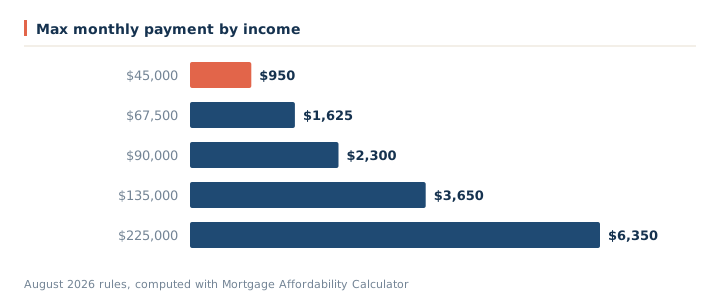
We ran 5 values of income through the calculator and left every other input at its default. As of August 2026, the output was:
| Income ($) | Max monthly payment ($) | Loan amount ($) | Home price affordable ($) |
|---|---|---|---|
| 45,000 | 950 | 150,300.28 | 210,300.28 |
| 67,500 | 1,625 | 257,092.58 | 317,092.58 |
| 90,000 | 2,300 | 363,884.88 | 423,884.88 |
| 135,000 | 3,650 | 577,469.49 | 637,469.49 |
| 225,000 | 6,350 | 1,004,638.7 | 1,064,638.7 |
Running income from $45,000 up to $225,000 moves max monthly payment from $950 to $6,350 — a spread of $5,400. That gap is the part a single headline rate never shows.
The same runs seen through loan amount
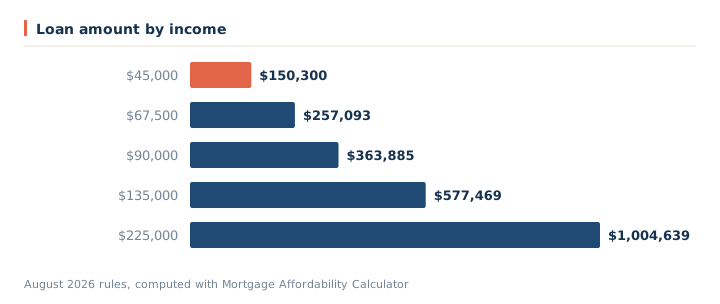
At $45,000, loan amount works out to $150,300; at $225,000 it is $1,004,639. Looking only at max monthly payment tends to understate how much the outcome shifts across that range.
Assumptions behind these figures
| Input | Value |
|---|---|
| Income | $90,000 |
| Monthly debts | $400 |
| Down payment | $60,000 |
| Rate | 6.5% |
| Term | 30 years |
| As of | August 2026 |
| Method | identical to /tools/mortgage-affordability-calculator |
Brackets, thresholds and rates change from year to year, so treat these as August 2026 figures for the 2026 tax year. For your own situation, open the Mortgage Affordability Calculator and enter your real numbers — the calculator runs the same code that produced every figure on this page.