A mortgage feels overwhelming for a specific reason, and it is not difficulty. It is unfamiliarity stacked on top of paperwork stacked on top of the largest number most people will ever sign for. The process itself follows the same orderly sequence it has for years. Learn the sequence and the dread turns into a checklist.
What follows is the entire journey, in the order it actually happens, with realistic timing and the documents you will be asked for at each turn.
The stage that decides everything happens before you call a lender
Most of the outcome is set in the months before anyone runs your credit. Two things matter most.
The first is credit. Your score moves your interest rate, your PMI cost, and whether you are approved at all. Pull your reports, dispute genuine errors, pay balances down so your utilization drops, and do not, under any circumstances, finance a car or open a card in the months before applying. The same loan at a better score can save tens of thousands across its life. This is unglamorous and it is the highest-paid work in the entire process.
The second is your debt-to-income ratio, which lenders care about intensely.
| Ratio | What it counts | Common comfort ceiling |
|---|---|---|
| Front-end | The housing payment only (PITI) | ~28% of gross income |
| Back-end | Housing plus all other debt | ~36%–43% of gross income |
If your back-end ratio is tight, retiring one small loan before you apply can expand what you qualify for more than a raise would. While you are here, ground the search in reality: the Down Payment Calculator turns a target into a monthly savings number, and the Mortgage Affordability Calculator gives you a price range before you fall for a listing you cannot finance comfortably.
Make the ratio concrete. A household grossing $7,500 a month at a 43% back-end ceiling can carry about $3,225 of total monthly debt. Subtract a $400 car payment and a $150 student loan and roughly $2,675 remains for the entire housing payment, principal, interest, taxes, insurance, and any PMI or HOA, not just principal and interest. Now watch the lever: clear that $400 car loan before applying and the housing room jumps to about $3,075, which at typical rates can lift the home price you qualify for by tens of thousands. This is why "pay off a small debt before applying" outperforms a modest raise: the raise is taxed and incremental, while removing a payment frees its full amount directly into the ratio the lender actually uses. The order of operations matters more than the size of the numbers.
Pre-approval comes before house tours, not after
A pre-approval is a lender's conditional commitment based on a genuine review of your credit, income, and assets. It is not a casual pre-qualification, which is little more than an estimate.
It comes first for three reasons. It tells you your real budget, anchored to your actual finances rather than optimism. It makes your offers credible, because sellers discard offers without one. And it surfaces problems while there is still time to fix them rather than at the worst possible moment. Expect a credit pull and a document request; the letter is usually good for 60 to 90 days.
The highest-paid hour: comparing lenders
This is the stage with the largest dollar payoff and the one buyers most often skip out of fatigue. Within three business days of a complete application, every lender must hand you a standardized Loan Estimate. Because the form is standardized, you can lay three of them next to each other and compare line by line. Request them around the same time so the rates are comparable.
Compare the APR, not just the rate, because a low headline rate can hide high fees and points. Look hard at origination charges, discount points, lender credits, and the third-party services you are allowed to shop. One worry to retire: rate-shopping inquiries inside a short window are generally bundled by credit-scoring models as a single inquiry, so comparing several lenders barely dents your score, and the savings from a better rate dwarf that concern many times over.
See why this hour pays so well. Two lenders on the same $320,000 loan: Lender A advertises 6.25% but charges two points and a heavy origination fee; Lender B offers 6.5% with minimal fees. Lender A's monthly payment looks lower in isolation, but fold in roughly $6,400 of points plus fees and the APR can land above Lender B's, and unless you hold the loan long enough to earn those upfront costs back through the lower rate, the "cheaper" loan is the expensive one. Over thirty years the gap between a well-shopped loan and the first offer a buyer accepts out of fatigue is routinely tens of thousands of dollars. There is no other ninety-minute task in adult financial life with a comparable payoff, which is exactly why it is the stage most worth pushing through the tiredness.
A realistic week-by-week timeline
| Stage | Typical duration | What is happening |
|---|---|---|
| Credit & DTI prep | Weeks to months (before applying) | The highest-value, least visible work |
| Pre-approval | 1–3 days after documents | Conditional commitment, good 60–90 days |
| Offer accepted to application | Varies with the search | Lender chosen, contract signed |
| Processing & appraisal | ~1–2 weeks | Independent valuation, document review |
| Underwriting & conditions | ~1–3 weeks | Verification, requests for more documents |
| Clear to close → closing | 3+ business days | Closing Disclosure window, then signing |
From formal application to keys, 30 to 45 days is the common span. The slow steps are rarely the lender's; they are documents arriving late and underwriting conditions answered slowly, both of which are inside your control. The buyers who close in thirty calm days and the buyers who slip to sixty stressful ones are usually separated by response time, not loan complexity.
Application and the document pile
Once you choose a lender and have an accepted offer, you apply formally. Underwriting runs on documents, so assemble them early rather than scrambling. You will need income proof such as recent pay stubs, two years of W-2s, and two years of tax returns if you are self-employed; asset statements for the last two to three months with a clear paper trail for any large or unusual deposit; a government ID and a list of current debts; and the purchase contract plus a homeowners insurance quote. A clean, complete package is the single biggest factor in a fast, calm closing. A messy one is the single biggest cause of delay.
Processing, appraisal, and underwriting
The lender orders an independent appraisal to confirm the home is worth at least what you agreed to pay. If it comes in low, you typically renegotiate the price, bring extra cash, or challenge the appraisal. This is a known pressure point, so do not be blindsided by it.
Meanwhile an underwriter verifies everything and judges the loan against three tests: capacity, meaning can you afford it; credit, meaning your history of repaying debt; and collateral, meaning whether the property adequately secures the loan. Underwriting almost always returns "conditions," which are requests for more documents or explanations. Answer them the same day if you can. Slow responses here are the most common reason a closing date slips.
There is one rule that overrides all the others during this window. Change nothing about your finances until the loan has funded. Do not switch jobs, finance a vehicle, open a credit line, move large sums between accounts, or make a big purchase. Lenders frequently re-verify just before closing, and a single surprise can collapse the loan after months of work.
Clear to close, then closing day
When the conditions are satisfied you are "clear to close." At least three business days before closing you receive the Closing Disclosure. Compare it carefully against your original Loan Estimate. Some figures are legally not allowed to rise, and others only within tolerances, so a large unexplained jump is a question to ask out loud, not a number to accept quietly.
On the day itself you do a final walkthrough, bring a government ID and the required funds by wire or cashier's check, sign the promissory note and the mortgage or deed of trust along with the closing documents, and receive the keys once funding confirms. From application to keys, the typical span is 30 to 45 days, varying with loan type, how fast documents move, and how busy the market is. Two of those three variables are inside your control.
How a clean file collapses in the last week: one story
The rule about changing nothing is abstract until you watch it break a deal. A buyer is clear to close on a Friday. That weekend, feeling celebratory, they finance a new car, $35,000 added to their debt in an afternoon. The lender does a final pre-funding credit re-pull on Monday, standard practice, and the new loan has moved the back-end ratio above the program's ceiling. The mortgage is suspended days before signing, after months of work, a paid appraisal, an inspection, and a moving truck already booked. Nothing about the home, the income, or the original approval was wrong; one optional purchase, made during the one window where it is fatal, undid all of it. This is not a rare horror story; it is the single most common late-stage failure, and it is entirely self-inflicted. The discipline is narrow and absolute: between pre-approval and the moment funds disburse, you make no new credit, no large transfers, no job change, and no big purchases, no exceptions, no "it's probably fine."
Where deals actually slip, ranked
After all of it, the failures cluster in a short, predictable list. A weak or absent pre-approval costs you homes and time. Taking only one quote costs you money for thirty years. Opening new credit mid-process gets loans denied at the last minute. Ignoring the full cost of ownership produces budget shock after move-in. And borrowing right up to the approved ceiling leaves no cushion for the first surprise. Notice that four of the five are entirely self-inflicted and entirely preventable.
The two documents that are quietly on your side
Most of this process is designed around you, but two standardized forms exist specifically to hand you leverage, and most buyers never use them as intended. The Loan Estimate arrives within three business days of a complete application, in an identical format from every lender, precisely so you can lay three of them side by side and compare the same lines, not marketing. The Closing Disclosure arrives at least three business days before closing in that same format, and the gap between the two is your protection: certain charges are legally not allowed to rise from Loan Estimate to Closing Disclosure, and others only within defined tolerances. So a fee that jumped without a corresponding change in your loan is not a number to absorb quietly, it is a discrepancy you are entitled to question before you sign. The three-day window is not a formality; it is the time the law gives you to do exactly this comparison. Buyers who treat both forms as paperwork to skim leave money and leverage on the table. Buyers who read them as the comparison and audit tools they were built to be routinely catch padding, errors, and drift worth far more than the hour it takes. The system is more fair than it feels, but only to the borrower who actually uses the parts built for them.
A 60-day action plan
If you want this as a sequence rather than an essay: spend the first stretch strengthening credit and cutting debt while you set a realistic budget with the Mortgage Affordability Calculator rather than the bank's maximum. Get pre-approved and immediately gather the document pile so it is ready. Compare at least three Loan Estimates by APR and choose. Make offers inside your budget, always with an inspection contingency. Then freeze every financial decision, respond to underwriting conditions within a day, verify the Closing Disclosure against your Loan Estimate, and sign. Buyers who treat the process as that checklist routinely save tens of thousands and close without drama. The drama is optional, and it is usually self-imposed.
Run the numbers
Everything below came out of this site's own Mortgage Payment Calculator. The figures are not quoted from anywhere else: each row is one run of the same calculation the tool page performs, using August 2026 rules. Put the same inputs in and you will get the same output.
How the result moves with price
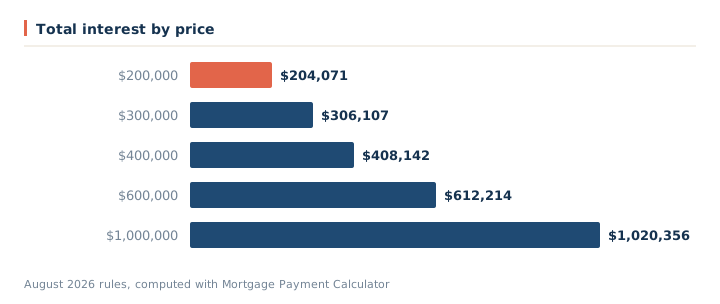
We ran 5 values of price through the calculator and left every other input at its default. As of August 2026, the output was:
| Price ($) | Total interest ($) | Total monthly payment ($) | Principal and interest ($) |
|---|---|---|---|
| 200,000 | 204,071.18 | 1,561.31 | 1,011.31 |
| 300,000 | 306,106.77 | 2,066.96 | 1,516.96 |
| 400,000 | 408,142.36 | 2,572.62 | 2,022.62 |
| 600,000 | 612,213.54 | 3,583.93 | 3,033.93 |
| 1,000,000 | 1,020,355.91 | 5,606.54 | 5,056.54 |
Running price from $200,000 up to $1,000,000 moves total interest from $204,071 to $1,020,356 — a spread of $816,285. That gap is the part a single headline rate never shows.
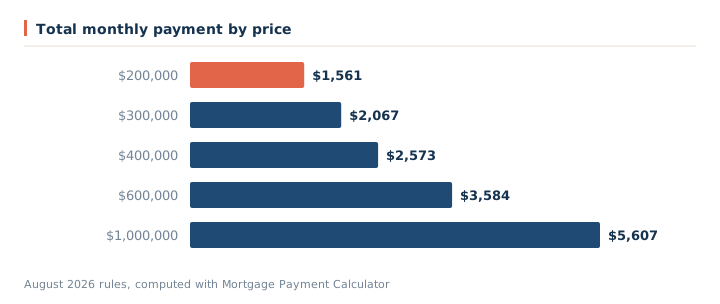
The same runs seen through total monthly payment
At $200,000, total monthly payment works out to $1,561; at $1,000,000 it is $5,607. Looking only at total interest tends to understate how much the outcome shifts across that range.
Assumptions behind these figures
| Input | Value |
|---|---|
| Price | $400,000 |
| Down payment percent | 20% |
| Rate | 6.5% |
| Term | 30 years |
| Property tax annual | $4,800 |
| Insurance annual | $1,800 |
| As of | August 2026 |
| Method | identical to /tools/mortgage-payment-calculator |
Brackets, thresholds and rates change from year to year, so treat these as August 2026 figures for the 2026 tax year. For your own situation, open the Mortgage Payment Calculator and enter your real numbers — the calculator runs the same code that produced every figure on this page.