You do not have to take a lender's or a calculator's word for your payment. The math behind it is one well-defined formula that has not changed in generations. Learning it does two useful things: it lets you sanity-check anyone, and it shows exactly which lever, rate, term, or principal, moves the cost and by how much.
Two different things people call "the payment"
"Mortgage payment" means two things, and the gap between them is where first-time buyers get hurt. Principal and interest is the loan repayment from the amortization formula, the number most calculators show first. PITI is that plus property taxes and homeowners insurance, plus mortgage insurance or HOA if they apply, and it is what actually leaves your bank account, usually through escrow. We will compute P&I precisely, then build up to PITI, because the entire category of first-time-buyer payment shock lives in the gap between those two numbers, and the only durable cure is being able to produce both yourself rather than trusting whichever one you were shown.
The formula
M = P × r(1 + r)ⁿ ÷ [ (1 + r)ⁿ − 1 ]
M is the monthly P&I, P is the amount borrowed, r is the annual rate divided by twelve as a decimal, and n is the number of payments, years times twelve. The two mistakes that wreck this for people are forgetting to divide the annual rate by twelve and forgetting to convert the percentage to a decimal, so 6.5% becomes 0.065.
A full worked example
A $400,000 home, 20% down, 6.5% rate, 30 years. The down payment is $80,000, so P is $320,000. The monthly rate r is 0.065 ÷ 12, about 0.00541667. The number of payments n is 30 × 12 = 360. Compute the growth factor first: (1.00541667) raised to the 360th power is about 7.0188. The numerator is r times that, roughly 0.038018. The denominator is that minus one, 6.0188. So M is 320,000 × (0.038018 ÷ 6.0188), which is 320,000 × 0.0063165, about $2,021 a month. That is the entire calculation. The Mortgage Payment Calculator does it instantly and lets you change inputs, but now you can verify it instead of trusting it.
Where that $2,021 actually goes in month one
Knowing the payment is half the literacy; knowing how it splits is the half that protects you. In the first month, interest is simply the balance times the monthly rate: $320,000 × 0.00541667, about $1,733. That leaves only $288 of your $2,021 going to principal. You paid $2,021 and your balance fell by $288. This is not a trick; it is what "amortization" means, and it is why early extra payments are so powerful and why the first years of a 30-year loan barely move the balance.
| Month | Payment | Interest | Principal | Balance after |
|---|---|---|---|---|
| 1 | $2,021 | $1,733 | $288 | $319,712 |
| 2 | $2,021 | $1,732 | $289 | $319,423 |
| 120 (year 10) | $2,021 | ~$1,430 | ~$591 | ~$263,000 |
| 300 (year 25) | $2,021 | ~$430 | ~$1,591 | ~$78,000 |
The payment never changes but its character inverts: early on it is almost all rent on borrowed money, and only near the end is it mostly buying the house. Anyone who understands this table is immune to two common manipulations, the pitch that a slightly lower payment via a longer term is "saving money," and the surprise that ten years of payments barely dented the balance.
A second worked example, so the formula is not a fluke
Reproduce it once more with different inputs to prove it is the method, not the numbers. A $250,000 loan, 7% rate, 30 years. Monthly rate r is 0.07 ÷ 12 = 0.00583333. Payments n is 360. The growth factor (1.00583333)^360 is about 8.116. Numerator: 0.00583333 × 8.116 ≈ 0.047344. Denominator: 8.116 − 1 = 7.116. So M = 250,000 × (0.047344 ÷ 7.116) = 250,000 × 0.0066532 ≈ $1,663 a month. Same five steps, different loan, no guesswork. Once you have done it twice you stop trusting black boxes not out of paranoia but because you no longer need to.
Watch each lever move it
| Change | New P&I | Effect |
|---|---|---|
| Rate 6.5% → 5.5% | ~$1,817 | −$204/mo, huge lifetime saving |
| Term 30 → 15 yrs | ~$2,789 | Higher payment, far less total interest |
| Principal $320k → $300k | ~$1,896 | A bigger down payment lowers it |
| Rate 6.5% → 7.5% | ~$2,237 | +$216/mo from one point of rate |
This is the concrete reason shopping the rate hard and choosing the term deliberately matter so much: small input changes compound across 360 payments.
Why the levers behave the way they do
The table shows the moves; the formula explains them, and the explanation is what makes you hard to mislead. Rate matters enormously because it compounds inside that growth factor over 360 periods, so a single percentage point is never "just one point", it is one point applied hundreds of times to a large balance, which is why a point of rate can swing the payment by hundreds of dollars. Term cuts the other way and confuses people: a shorter term raises the monthly payment because n is smaller, yet it slashes total interest because you are borrowing the money for far less time, so "lower payment" and "less expensive" are often opposites, not synonyms. Principal moves the payment in a straight line, every dollar borrowed is a dollar that accrues interest, which is the entire mechanical case for a larger down payment. Understanding why each lever moves the payment is more durable than memorizing the table, because it lets you predict the direction of any change before you compute it and catch a quoted payment that points the wrong way.
The mistakes that wreck a hand calculation
When the formula "doesn't work," it is almost always one of a short list of errors, not the math. Using the annual rate instead of dividing by twelve inflates everything wildly. Leaving the rate as a percentage instead of a decimal, 6.5 instead of 0.065, does the same. Using years instead of months for n. Rounding the growth factor too early, that exponent is sensitive, so carry several decimals until the end. And computing only P&I and then being shocked at the real bill, which is the conceptual error rather than an arithmetic one. Run the five steps in order, divide the rate by twelve, convert to a decimal, set n in months, hold precision until the last step, then build up to PITI, and the formula is reliable every time. The reason to learn the failure modes is that a number you can both produce and debug is a number no salesperson can bend.
From P&I to the payment you actually send
The formula gives P&I only. Property tax is roughly home value times the local effective rate divided by twelve; on a $400,000 home at 1.0% that is about $333 a month, and the Property Tax Calculator estimates yours. Homeowners insurance is the annual premium divided by twelve, perhaps $150 on a $1,800 policy. Add mortgage insurance if you put less than 20% down. In our 20%-down example the full picture is about $2,021 plus $333 plus $150, roughly $2,504 of PITI. The $483 gap between the formula's answer and the real payment is precisely why budgeting off P&I alone is the classic beginner mistake.
What an extra $200 a month actually does
The amortization split explains the most reliable wealth move in home financing. Add $200 to that $2,021 payment, earmarked entirely to principal, and in month one your balance falls by $488 instead of $288. Because every dollar of principal you retire early erases all the future interest that dollar would have generated, a steady extra $200 on a $320,000 loan at 6.5% typically cuts roughly five to seven years off the loan and saves tens of thousands in total interest, far more than the $200 itself sums to, because you are deleting compounding, not just prepaying. This is also why the "lower payment via a longer term" pitch is usually backwards: it does the exact opposite, slowing principal and multiplying interest. You do not need a product or a refinance to do this; you need the formula's logic and the discipline to apply the extra to principal, not to next month's payment.
Rate is not APR, and the gap is a fee in disguise
The formula uses the note rate, but lenders also quote APR, and confusing them costs money. The rate drives your monthly payment through the formula above. The APR folds many of the loan's costs, points and certain fees, into a single annualized figure, which is why APR is usually a little higher than the rate. The practical use is direct: compare loans by APR, not by the headline rate, because a tempting rate wrapped in heavy fees can carry a worse APR than a slightly higher rate with none. The payment formula tells you what you will pay monthly; the APR tells you what the loan truly costs to obtain. You need both, and a lender who emphasizes only the rate is showing you the friendlier of the two numbers.
The biweekly "secret" the formula exposes
You will be sold biweekly payment programs as a clever way to pay off the loan years early, sometimes for a setup fee. The formula shows exactly what they are. Paying half your monthly payment every two weeks means 26 half-payments a year, which is 13 full payments instead of 12. The entire effect is one extra monthly payment per year applied to principal, accelerating the same amortization you already saw collapse interest when extra principal goes in early. There is nothing proprietary about it and no reason to pay a fee for it; you can replicate the whole benefit by dividing your payment by twelve and adding that to principal each month, or by making one extra payment a year. The math literacy is the point: once you understand the amortization table, "biweekly acceleration" stops being a product and becomes an obvious consequence you can do for free.
Where mortgage insurance fits the equation
The formula gives P&I; PITI adds taxes and insurance; and if your down payment is under 20% on a conventional loan there is one more line, PMI, that sits on top until you reach roughly 20% equity. It matters here for one reason: it is the only piece of the real payment that is designed to disappear. Taxes and homeowners insurance are permanent and tend to rise; P&I is fixed; PMI is temporary and cancellable. So the honest "what will I actually pay" for a low-down buyer is P&I from the formula, plus tax, plus insurance, plus PMI for now, with the mental footnote that the last term is the one you can engineer away by reaching the equity threshold. Knowing which components are permanent, which are fixed, and which are removable is the difference between a payment you understand and a payment that merely happens to you.
When you have no calculator
Two field tricks. At about 6.5% over 30 years, P&I is roughly $6.30 per $1,000 borrowed, so a $320,000 loan is about 320 × $6.30 ≈ $2,016, close to the exact $2,021. And in many areas, mentally adding 25% to 35% on top of P&I gives a rough PITI ballpark, though that piece varies enormously by location and should be verified locally. Use these for quick conversations and the formula or the Mortgage Payment Calculator for decisions. The point of learning the math is not to do arithmetic for fun. It is that a number you can reproduce is a number no one can use to mislead you. When a lender's payment, a listing's "estimated monthly," or an online figure does not match your own, you no longer have to wonder who is right; you check the five inputs, find the assumption that differs, taxes left out, a longer term slipped in, a rate that is really an APR, and the disagreement explains itself. That is the whole return on ten minutes with one formula: not the answer, which any calculator gives you, but the ability to interrogate the answer, which is the only thing that keeps the largest purchase of your life from being negotiated in numbers you cannot see. Calculators are not the enemy here, and neither are lenders; the Mortgage Payment Calculator will out-compute you every time and should do the work. The point is narrower and more durable: a borrower who can derive the number is a borrower who can tell when the number is wrong, and on a six-figure thirty-year commitment that single capability is worth more than any rate you could have shopped your way into. The formula has not changed in generations and it will not change after you learn it; that permanence is the point, because it means ten minutes spent now is a defense that keeps working for every loan, every refinance, and every "estimated payment" you will ever be handed for the rest of your life.
Run the numbers
Everything below came out of this site's own Mortgage Payment Calculator. The figures are not quoted from anywhere else: each row is one run of the same calculation the tool page performs, using August 2026 rules. Put the same inputs in and you will get the same output.
How the result moves with price
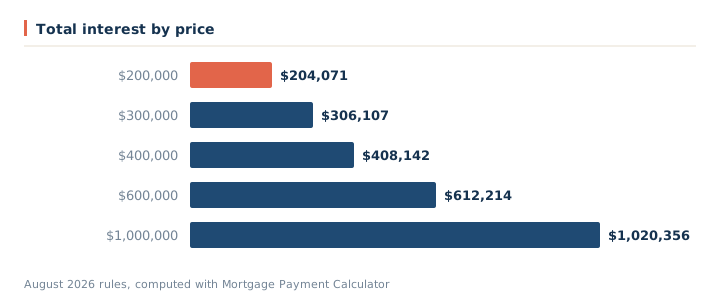
We ran 5 values of price through the calculator and left every other input at its default. As of August 2026, the output was:
| Price ($) | Total interest ($) | Total monthly payment ($) | Principal and interest ($) |
|---|---|---|---|
| 200,000 | 204,071.18 | 1,561.31 | 1,011.31 |
| 300,000 | 306,106.77 | 2,066.96 | 1,516.96 |
| 400,000 | 408,142.36 | 2,572.62 | 2,022.62 |
| 600,000 | 612,213.54 | 3,583.93 | 3,033.93 |
| 1,000,000 | 1,020,355.91 | 5,606.54 | 5,056.54 |
Running price from $200,000 up to $1,000,000 moves total interest from $204,071 to $1,020,356 — a spread of $816,285. That gap is the part a single headline rate never shows.
The same runs seen through total monthly payment
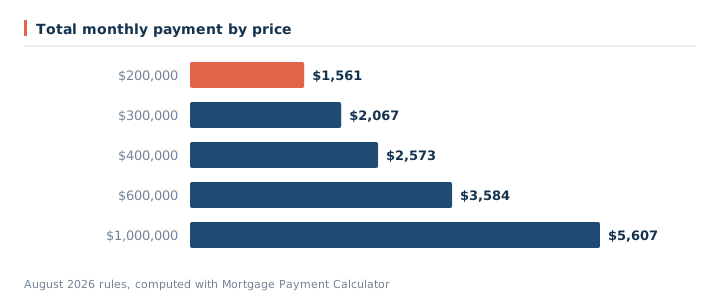
At $200,000, total monthly payment works out to $1,561; at $1,000,000 it is $5,607. Looking only at total interest tends to understate how much the outcome shifts across that range.
Assumptions behind these figures
| Input | Value |
|---|---|
| Price | $400,000 |
| Down payment percent | 20% |
| Rate | 6.5% |
| Term | 30 years |
| Property tax annual | $4,800 |
| Insurance annual | $1,800 |
| As of | August 2026 |
| Method | identical to /tools/mortgage-payment-calculator |
Brackets, thresholds and rates change from year to year, so treat these as August 2026 figures for the 2026 tax year. For your own situation, open the Mortgage Payment Calculator and enter your real numbers — the calculator runs the same code that produced every figure on this page.